Synonyms for poor are useful for anyone who wants to speak or write better English. Students use it to write better essays. Professionals use it to sound polished at work. English learners use it to speak with more confidence. Everyone needs the right word, at the right time.
Students use it to write better essays. Professionals use it to sound polished at work. English learners use it to speak with more confidence. Everyone needs the right word, at the right time.
The word “poor” is simple, but it gets used too often. Over time, it starts to feel dull and repetitive. That is exactly why synonyms for poor are worth learning. They give you more choices and more confidence when you speak or write.
Every word carries its own feeling. Some sound formal, some sound casual, and some carry emotion. This guide helps you pick the right synonyms for poor based on your situation and your audience.
Why Do We Need Synonyms for Poor?
The word “poor” has many meanings. It can describe a person with little money. It can describe low quality work and it can describe bad health and it can even express sympathy, like saying “poor thing.”
The word “poor” has so many meanings. One single synonym cannot cover them all. Each meaning needs its own word. That is why we need different synonyms for poor based on context. Using the wrong synonym in the wrong place can confuse your reader. So this guide splits the words into clear categories.
Poor Synonym
- Poor synonym is an informational keyword used by people looking for alternative words for poor in different contexts, such as financial status, quality, performance, ability, or condition.
- Users generally want synonyms, meanings, example sentences, antonyms, and usage tips to improve their vocabulary and writing.
- The keyword covers everyday English, academic writing, business communication, and creative writing.
- It helps readers choose the most accurate word based on the intended meaning and context.
- This topic is valuable for students, writers, teachers, bloggers, and English learners seeking to expand their vocabulary.
Key Points
- Context-based synonyms for financial, quality, performance, and descriptive uses.
- Clear meanings to explain the differences between similar words.
- Example sentences showing the correct use of each synonym.
- Antonyms and comparisons to help users understand opposite and related terms.
- Writing tips for choosing the most suitable synonym in essays, professional writing, and everyday English.
Synonyms for Poor (Meaning: Lacking Money)
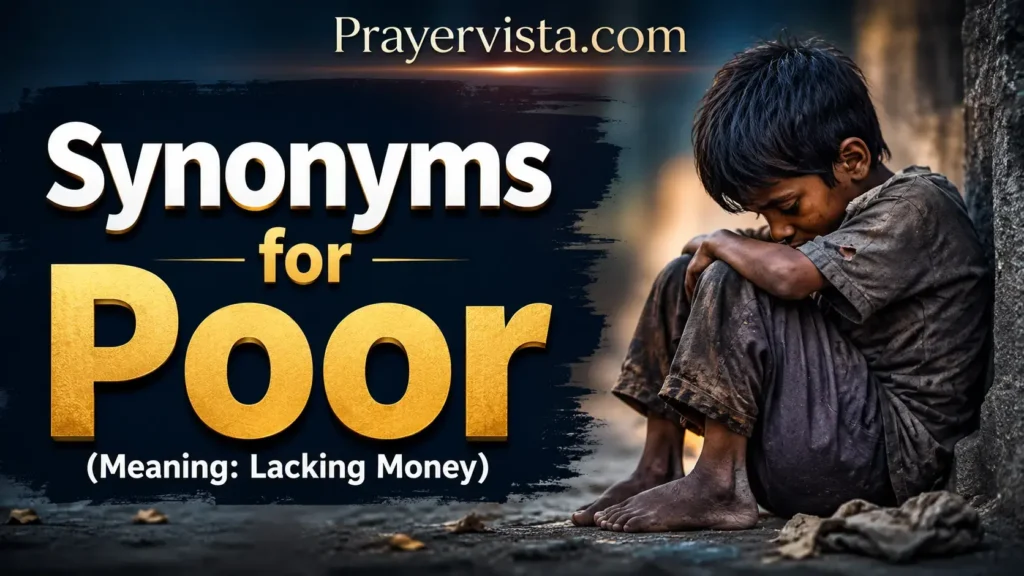
This is the most common use of the word “poor.” It means someone does not have enough money. Below are strong synonyms for poor in this financial sense.
Impoverished
- Meaning: extremely poor
- Example: The village was impoverished.
Destitute
- Meaning: nothing left
- Example: The flood left them destitute.
Needy
- Meaning: lacking basics
- Example: The charity helps needy kids.
Penniless
- Meaning: no money at all
- Example: He arrived penniless.
Broke
- Meaning: out of money
- Example: I’m broke until payday.
Underprivileged
- Meaning: fewer opportunities
- Example: The program aids underprivileged students.
Insolvent
- Meaning: legally unable to pay
- Example: The firm became insolvent.
Bankrupt
- Meaning: declared unable to pay
- Example: The store went bankrupt.
Poverty-stricken
- Meaning: deeply affected by poverty
- Example: The region is poverty-stricken.
Deprived
- Meaning: lacking basic needs
- Example: Deprived areas lack schools.
Hard up
- Meaning: short on money
- Example: We were hard up that winter.
Down and out
- Meaning: poor, no resources
- Example: He was down and out.
Impecunious
- Meaning: poor, literary tone
- Example: The impecunious writer struggled.
Indigent
- Meaning: poor, legal term
- Example: A lawyer aided the indigent defendant.
Squint
- Meaning: informal, British slang
- Example: I’m squint this week.
These synonyms for poor work well when talking about money. Choose formal words like “impoverished” or “destitute” for essays and reports. Choose casual words like “broke” or “skint” for daily talk.
Comparison Table 1: Synonyms for Poor (Money) – Formal vs Casual
| Synonym | Tone | Best Used In |
| Impoverished | Formal | Essays, reports |
| Destitute | Formal | News, academic writing |
| Insolvent | Formal/Legal | Business, legal documents |
| Indigent | Formal/Legal | Court, legal writing |
| Needy | Neutral | Everyday speech |
| Underprivileged | Neutral | Social, charity contexts |
| Deprived | Neutral | Social writing |
| Broke | Casual | Daily conversation, texting |
| Hard up | Casual | Informal talk |
| Squint | Casual | British informal speech |
Synonyms for Poor (Meaning: Low Quality)
Sometimes “poor” does not mean money at all. It means something is bad or weak in quality. Here are useful synonyms for poor in this sense.
Substandard
- Meaning: below normal standard
- Example: The wiring was substandard.
Inferior
- Meaning: lower quality
- Example: This fabric feels inferior.
Deficient
- Meaning: lacking something needed
- Example: The report was deficient.
Inadequate
- Meaning: not good enough
- Example: The training was inadequate.
Unsatisfactory
- Meaning: formal, below expectations
- Example: His performance was unsatisfactory.
Shoddy
- Meaning: carelessly made
- Example: The shoddy repair broke fast.
Second-rate
- Meaning: not the best quality
- Example: It was a second-rate hotel.
Mediocre
- Meaning: average or below
- Example: The food was mediocre.
Weak
- Meaning: simple, lacking strength
- Example: The team had weak defense.
Lacking
- Meaning: missing detail
- Example: The essay was lacking structure.
Below par
- Meaning: common idiom, subpar
- Example: His work was below par.
Faulty
- Meaning: broken or defective
- Example: Faulty wiring caused a fire.
Flawed
- Meaning: has a defect
- Example: The plan was flawed early.
Unimpressive
- Meaning: no good impression
- Example: The results were unimpressive.
Sloppy
- Meaning: careless work or style
- Example: The sloppy writing was hard to read.
These synonyms for poor are perfect for reviews, reports, and criticism. They help you describe quality problems clearly.
Comparison Table 2: Synonyms for Poor Quality – Meaning at a Glance
| Synonym | Meaning | Example Use |
| Substandard | Below normal standard | Product/service reviews |
| Inferior | Lower quality compared to others | Comparisons |
| Deficient | Lacking something needed | Reports, research |
| Inadequate | Not good enough | Training, resources |
| Unsatisfactory | Formal, used in reviews | Performance reviews |
| Shoddy | Carelessly made | Repairs, workmanship |
| Mediocre | Average or below average | Food, general quality |
| Faulty | Broken or defective | Products, machines |
Synonyms for Poor (Meaning: Bad Health or Condition)
“Poor” also describes bad physical or mental condition. Doctors, teachers, and writers use this meaning often. Here are strong synonyms for poor health and condition.
Feeble
- Meaning: very weak
- Example: He gave a feeble smile.
Ailing
- Meaning: sick or unwell
- Example: The economy was ailing.
Sickly
- Meaning: often ill
- Example: The sickly child missed school.
Delicate
- Meaning: fragile, easily harmed
- Example: Her health was delicate.
Weakened
- Meaning: made weaker
- Example: The virus weakened him.
Unwell
- Meaning: polite, mildly sick
- Example: She felt unwell after the trip.
Debilitated
- Meaning: formal, medically weak
- Example: Illness left him debilitated.
Rundown
- Meaning: tired, unhealthy
- Example: I feel rundown after exams.
Comparison Table 3: Synonyms for Poor Health – Where They Fit Best
| Synonym | Field | Tone |
| Frail | Medical, care | Gentle |
| Feeble | Storytelling, everyday | Descriptive |
| Ailing | General, economic writing | Neutral |
| Sickly | Everyday, storytelling | Casual |
| Debilitated | Medical writing | Formal |
| Unwell | Everyday care | Polite |
| Rundown | Casual, personal | Informal |
| Infirm | Medical, care | Formal |
Synonyms for Poor (Meaning: Expressing Sympathy)
Sometimes “poor” is used to show pity or sympathy. For example, “poor dog” or “poor girl.” Here are gentle synonyms for poor for this use.
- Unfortunate – Example: “The unfortunate man lost his home.”
- Pitiable – Example: “It was a pitiable sight.”
- Wretched – Example: “The wretched child had nowhere to go.”
- Miserable – Example: “He looked miserable after the news.”
- Sad – A simple, common choice. Example: “The sad little kitten was alone.”
Comparison Table 4: Synonyms for Poor (Sympathy) – Intensity Level
| Synonym | Intensity | Example Use |
| Sad | Mild | Everyday, casual |
| Unfortunate | Mild-Moderate | Formal, storytelling |
| Pitiable | Moderate | Descriptive writing |
| Miserable | Strong | Emotional writing |
| Wretched | Strong | Literary, dramatic writing |
How to Choose the Right Synonym

Choosing the correct word depends on three things.
First, think about context. Is the sentence about money, quality, health, or emotion? Match the synonym to that meaning.
Second, think about tone. Formal writing needs formal words. Casual writing allows casual words. “Impecunious” fits an essay. “Broke” fits a text message.
Third, think about your audience. Academic readers expect precise vocabulary. General readers prefer simple, clear words.
A good trick is to read your sentence aloud. If the synonym sounds unnatural, try another one. Writing should feel smooth, not forced.
Common Mistakes When Using Synonyms for Poor
Many writers make small mistakes when replacing “poor” with a synonym. Let’s look at a few.
- Mistake 1: Using formal words in casual writing. Saying “he is impecunious” in a text message sounds odd. Simple words like “broke” work better there.
- Mistake 2: Mixing meanings. Do not use “shoddy” to describe a person’s financial state. “Shoddy” refers to quality, not money.
- Mistake 3: Overusing one synonym. Even a good synonym becomes boring if repeated too much. Rotate between different words.
- Mistake 4: Ignoring connotation. Some words carry strong emotional weight. “Destitute” feels heavier than “needy.” Choose based on the emotion you want to create.
Synonyms for Poor in Sentences: Practice Examples
Let’s see how these words work in real sentences.
- “The impoverished family struggled through the winter.”
- “His essay showed substandard research.”
- “The frail old man walked slowly.”
- “It was a pitiable scene at the shelter.”
- “She felt rundown after the long flight.”
- “The startup went bankrupt within a year.”
- “The hotel service was mediocre at best.”
- “The destitute refugees needed urgent help.”
Benefits of Learning Synonyms for Poor
Learning these words helps in many ways.
- Improves your vocabulary. You can express ideas with more precision and variety.
- Strengthens your writing. Essays, articles, and stories sound more professional.
- Helps in exams. English tests often reward strong vocabulary and varied word choice.
- Improves speaking skills. Conversations sound more natural when you avoid repeating the same word.
- Boosts SEO writing. Content writers use synonyms to reduce repetition while keeping the same meaning.
Quick Reference List of Synonyms for Poor
Here is a short summary list for quick review.
- Financial poverty: impoverished, destitute, needy, penniless, broke, underprivileged, bankrupt
- Poor quality: substandard, inferior, deficient, inadequate, shoddy, mediocre, faulty
- Poor health: frail, feeble, ailing, sickly, delicate, debilitated
- Sympathy: unfortunate, pitiable, wretched, miserable, sad
Keep this list handy. Use it whenever the word “poor” feels repetitive in your writing.
Synonyms for Poor in Everyday Conversations

Native speakers rarely stick to one word. They switch synonyms naturally. It depends on the situation and it depends on the person. It depends on the mood. Understanding this pattern helps you sound more fluent and natural.
At work, people avoid the word “poor.” They say “unsatisfactory feedback” instead. It sounds more professional. It sounds more professional and polished. In a meeting, someone might say “the numbers were below par this quarter” instead of “the numbers were poor.” This small shift makes a big difference in how serious and credible you sound.
At home, conversations are more relaxed. Someone might say “we’re a bit skint this month” instead of “we are poor this month.” A friend might text “I’m totally broke till Friday” rather than “I am poor.” These casual words feel warmer, friendlier, and more relatable in everyday talk.
Test Your Knowledge
Learning words is easy, but using them is what really counts. Try this short exercise. Fill in each blank with the best synonyms for poor from what you’ve learned above.
- After losing his job, he became completely _______. (Hint: means having no money at all)
- The report was _______ in detail and needed more research. (Hint: means lacking something needed)
- The _______ old woman needed help crossing the street. (Hint: means physically weak)
- It was a _______ sight, seeing the stray dog shivering in the rain. (Hint: means causing pity)
- The company went _______ after years of poor management. (Hint: means legally unable to pay debts)
- The hotel room was _______ compared to the pictures online. (Hint: means below the normal standard)
- She felt _______ after the long flight and needed rest. (Hint: means tired and unhealthy)
- The charity works to support _______ children in the region. (Hint: means lacking basic needs or opportunities)
Answers:
- Destitute or penniless
- Deficient
- Frail
- Pitiable
- Bankrupt
- Substandard
- Rundown
- Underprivileged or deprived
Another Quick Activity
Try this simple trick. Take any sentence with the word “poor.” Rewrite it three times. Use a different synonym each time.
- Original: “The food was poor.”
- Version 1: “The food was mediocre.”
- Version 2: “The food was substandard.”
- Version 3: “The food was unsatisfactory.”
Notice how each version feels slightly different in tone. Practice for just five minutes daily. It trains your brain automatically. Within a few weeks, these synonyms for poor will come naturally, without even thinking.
FAQs
What are 5 synonyms for poor?
Five common synonyms for poor are: broke, needy, destitute, impoverished, and penniless. Each works well in slightly different situations, from casual talk to formal writing.
What are 50 synonyms listed?
A full list covers four main categories. Money problems: impoverished, destitute, broke, penniless, underprivileged. Low quality: substandard, inferior, shoddy, mediocre. Bad health: frail, feeble, sickly, debilitated. Sympathy: unfortunate, pitiable, wretched. You’ll find the complete list broken down above.
What can I use instead of poor?
Instead of “poor,” try these words. For money: needy, broke, impoverished, destitute. For quality, try substandard or inferior and for health, try frail or sickly. The right choice depends on what you’re actually describing.
What’s a polite way to say “poor”?
Polite and gentle alternatives include underprivileged, needy, disadvantaged, and low-income. These words sound gentle, not harsh. They avoid judgment. They fit formal or sensitive conversations.
Another word for poor person
A person with little money can be called needy, destitute, underprivileged, or impoverished. “Underprivileged” and “needy” sound gentler, while “destitute” describes extreme poverty.
Another word for poor family
A poor family can be described as underprivileged, low-income, needy, or struggling. “Low-income” fits formal writing. It sounds official. “Struggling” fits everyday talk. It sounds more relatable.
Another word for poor as in sad
Sometimes “poor” means sympathy, not money. Good alternatives are: unfortunate, pitiable, wretched, miserable. For example, “poor thing” can become “the unfortunate creature.”
Very poor synonyms
For extreme poverty, use stronger words. Try: destitute, impoverished, penniless, poverty-stricken. These carry more weight than simple words like “needy” and show a more severe situation.
Conclusion
Learning synonyms for “poor” makes your English richer. It makes your English more expressive. These words give you the power to express yourself better. Instead of repeating one word, you now have many strong options to choose from.
You can describe money problems with words like “impoverished” or “destitute.” You can describe bad quality with words like “shoddy” or “substandard.” and you can describe weak health with words like “frail” or “ailing.” They can even show sympathy with words like “unfortunate” or “pitiable.”
The real secret is context. Always match the synonyms for poor to what you actually mean. A formal word suits an essay. A casual word suits daily talk. This one habit will make your English sound natural and confident.
If you’re a student, a professional, or an English learner this list is your go-to spot. Find the right word, every time. Keep coming back to it whenever “poor” feels repetitive.
Practice these synonyms for poor in your own sentences. The more you use them, the more naturally they will come to you. Strong writing is not about big words, it’s about choosing the right word, every single time.
Read More Articles…..
- Best Synonyms for Friend PDF with Meanings and Examples 2026
- Easy Synonyms for Light Examples in Daily English Writing
- The Smart Writer’s Guide to 50+ Synonyms for Failure pdf

Hi, I’m Sophia Reynolds, a content writer at Prayervista.com. I love writing clear and engaging content about synonyms and vocabulary. My goal is to help readers understand word meanings, improve their English, and choose the right words with confidence through simple and accurate explanations.