“Know your enemy and know yourself, and you can fight a hundred battles without disaster.” Sun Tzu wrote that line centuries ago, and it still holds up. Understanding comes first, and words are how that understanding gets shaped.
“Enemy” is one of the oldest words in the English language. It’s also one of the laziest, at least the way most people use it. We reach for it out of habit, not because it’s actually the right word for what we’re describing. This is exactly why synonyms for enemy matter more than most writers realize.
Here’s the thing: a business competitor isn’t a threat, and a rival isn’t automatically a foe. The word you pick changes the emotional temperature of a sentence, sometimes without you even realizing it.
This guide walks through more than fifty synonyms for enemy, grouped by tone and context, so you can stop defaulting to the same word every time someone or something stands in your way. It also covers when “enemy” is still the right call, because sometimes it is.
By the end, you’ll have a working vocabulary for describing opposition built entirely around practical synonyms for the enemy, whether you’re writing fiction, a business report, or just venting about a difficult coworker.
Why “Enemy” Gets Overused
It’s short. It’s familiar. It requires zero thought. That’s exactly why it shows up so often in writing that could use something sharper, and it’s also why so many readers actively search for synonyms for enemy before they publish.
But “enemy” carries real weight. It implies hostility that’s active, often personal, sometimes permanent. A sibling rivalry isn’t warfare. A competitor isn’t plotting your downfall in a bunker somewhere. Most of the time, the situation calls for something with less drama.
Overuse also has a cost. The more often a word appears, the less it registers with readers, the same way constantly calling something “important” eventually makes nothing sound important at all.
There’s a credibility angle too. A writer who labels every disagreement an “enemy” situation starts to sound less like someone with judgment and more like someone reaching for the nearest word. Distinguishing between a critic, a rival, and a genuine adversary signals that you actually understand the conflict you’re describing.
How to Pick the Right Word for the Situation?

Start by asking what kind of opposition you’re actually dealing with. A courtroom dispute, a sports rivalry, and an actual war all involve conflict, but they don’t call for the same vocabulary, not even close.
Stakes matter first. Low risk, temporary friction usually calls for something like “rival,” “competitor,” or “opponent.” Real harm, danger, or long term hostility calls for something heavier: “aggressor,” “adversary,” “nemesis.”
Audience matters just as much. Calling a competing company an “enemy” in a business article tends to sound unprofessional, maybe even a little unhinged. “Competitor” says the same thing without the drama.
Genre plays a role too. Fiction has room for “villain,” “archenemy,” or “usurper,” words that would feel out of place in a news report, where “opposing faction” or “hostile force” do the job more precisely.
And don’t skip relationship history. “Frenemy” carries complexity, shared history, mixed feelings. A stranger who shows up hostile doesn’t need that nuance; “attacker” or “aggressor” is more direct and more honest. Thinking through all of this is really the fastest way to land on the right synonyms for enemy for any piece of writing.
Enemy vs. Related Words: What’s the Real Difference
People often use “enemy,” “rival,” “opponent,” and “villain” as if they mean the same thing. They don’t, and mixing them up is one of the most common reasons writers reach for weak synonyms for enemy without realizing it.
An “opponent” simply competes against you, often within rules, like a chess match or a debate. There’s no implied hostility. A “rival” adds history and repetition, the same two people or teams competing again and again over time. An “enemy” adds something heavier: genuine hostility, sometimes lasting, sometimes dangerous. A “villain” belongs mostly to storytelling, where a character’s actions are framed as morally wrong within a plot.
Here’s a quick side by side breakdown to make the distinction clearer:
| Word | Implies Hostility | Implies Ongoing Conflict | Common Setting |
|---|---|---|---|
| Opponent | No | No | Games, debates, sports |
| Rival | Sometimes | Yes | Business, sports, personal history |
| Enemy | Yes | Often | War, politics, serious conflict |
| Villain | Yes | Yes | Fiction, film, storytelling |
Once this distinction is clear, choosing between synonyms for enemy stops being guesswork. You’re no longer picking a word because it sounds strong. You’re picking it because it accurately describes the level of hostility actually present in the situation.
Common Synonyms for Enemy
These are the everyday go-tos, good for general writing, conversation, and storytelling.
- Foe: hostile or opposed to someone, with a slightly literary or dramatic edge. Example: The two warriors had been foes since childhood.
- Adversary: a person or group in active opposition. Example: The lawyer faced a skilled adversary in court.
- Opponent: someone competing against another, in a contest, game, or debate. Example: She shook hands with her opponent after the match.
- Rival: competing for the same goal, position, or advantage. Example: The two companies have been rivals for over a decade.
- Antagonist: actively hostile, often used for storytelling. Example: The novel’s antagonist manipulates every character around him.
- Nemesis: a long standing rival who seems impossible to beat. Example: The detective finally confronted his nemesis.
- Competitor: striving for the same market, prize, or outcome. Example: The startup studied its biggest competitor closely.
- Hostile party: a group or individual acting with clear opposition. Example: Negotiators tried to calm the hostile party at the table.
- Attacker: someone initiating aggression. Example: Security cameras captured the attacker leaving the building.
More Everyday Synonyms for Enemy
These remaining alternatives round out the everyday list, useful anywhere the first set doesn’t quite fit.
- Assailant: someone who physically attacks another. Example: Police are still searching for the assailant.
- Aggressor: the one who starts a conflict. Example: International leaders condemned the aggressor’s actions.
- Combatant: actively involved in a fight or war. Example: The treaty required all combatants to lay down their weapons.
- Opposer: someone who resists or argues against a position. Example: Every proposal had at least one vocal opposer.
- Detractor: someone who criticizes or belittles. Example: Despite the criticism, she ignored her detractors and kept working.
- Challenger: competing for a title or position. Example: The reigning champion now faces a determined challenger.
- Foil: a character whose traits contrast with and highlight another’s. Example: The quiet assistant served as a foil to the loud manager.
- Contender: competing seriously for a prize or title. Example: Three contenders remain in the race for mayor.
Formal and Political Synonyms for Enemy

These show up in diplomacy, journalism, and government communication, where tone needs to stay measured even when the subject isn’t.
- Adversarial power: a nation positioned against another. Example: The two adversarial powers avoided direct confrontation.
- Belligerent: engaged in war or conflict. Example: The treaty named both belligerents in the agreement.
- Opposing faction: a group holding an opposing position within a larger conflict. Example: The opposing faction rejected the ceasefire terms.
- Rival state: a country in direct competition or conflict. Example: Trade tensions grew between the two rival states.
- Insurgent: someone rebelling against established authority. Example: Government forces clashed with insurgents near the border.
- Dissident: someone openly opposing official policy. Example: The dissident was placed under close watch.
- Opposition leader: a political figure representing views against the ruling party. Example: The opposition leader criticized the new legislation.
- Hostile force: an organized group acting with aggression. Example: Troops were deployed to counter the hostile force.
- Enemy combatant: a formal military term for someone fighting against a state’s forces. Example: The tribunal reviewed the status of each enemy combatant.
- Threat actor: a person or entity responsible for hostile or damaging action, often in security contexts. Example: Analysts traced the breach back to a known threat actor.
Literary and Dramatic Synonyms for Enemy
Fiction, film, and poetry lean on words that do double duty: meaning plus atmosphere.
- Archenemy: someone’s greatest, most persistent enemy. Example: Every hero eventually meets their archenemy.
- Villain: a character whose actions drive the story’s conflict. Example: The villain’s plan slowly unraveled by the final act.
- Persecutor: someone who mistreats or harasses over time. Example: The memoir described her childhood persecutor in painful detail.
- Tormentor: someone who causes ongoing suffering. Example: Years later, she finally confronted her old tormentor.
- Oppressor: a person or group that unfairly dominates others. Example: The uprising was aimed directly at the oppressor’s rule.
- Traitor: someone who betrays a person, cause, or country. Example: The kingdom never forgave the traitor.
- Usurper: someone who seizes power unlawfully. Example: The rightful heir plotted against the usurper’s throne.
- Malefactor: someone who commits wrongdoing, more common in older or formal writing. Example: The town gathered to identify the malefactor.
Everyday and Casual Synonyms for Enemy
For situations where “enemy” would sound way too intense.
- Hater: someone who criticizes or resents without much justification. Example: She learned to ignore online haters years ago.
- Frenemy: part friend, part rival, at the same time. Example: Their friendship always had a frenemy dynamic.
- Troublemaker: someone who causes minor problems or conflict. Example: The new intern quickly earned a reputation as a troublemaker.
- Sore loser: someone who reacts badly to losing. Example: He refused to shake hands, acting like a sore loser.
- Nuisance: a minor source of annoyance. Example: The noisy neighbor became a constant nuisance.
- Critic: someone who points out flaws or disapproves. Example: Every public figure eventually attracts a few harsh critics.
Synonyms for Enemy by Intensity
Word choice is really about calibration. Here’s a quick way to gauge how strong a term actually sounds.
| Mild | Moderate | Strong |
| Critic | Rival | Nemesis |
| Detractor | Opponent | Archenemy |
| Sore loser | Competitor | Aggressor |
| Nuisance | Challenger | Oppressor |
| Hater | Adversary | Persecutor |
Mild works for everyday friction. Strong should be saved for situations that genuinely involve harm or real hostility, otherwise it reads as exaggeration.
Formal vs. Casual Synonyms for Enemy
| Formal | Casual |
| Adversary | Rival |
| Belligerent | Troublemaker |
| Opposing faction | The other side |
| Threat actor | Hater |
| Oppressor | Bully |
If you’re writing a report, go left. If you’re texting a friend about drama, go right.
Synonyms for Enemy by Context
| Context | Recommended Synonyms |
| Sports and games | Opponent, Rival, Challenger, Contender |
| Business and workplace | Competitor, Vocal critic, Opposing party |
| Politics and diplomacy | Opposition leader, Rival state, Belligerent |
| Fiction and storytelling | Villain, Archenemy, Antagonist, Usurper |
| Everyday conversation | Hater, Frenemy, Troublemaker |
Synonyms for Enemy in Business and Workplace Writing
Workplace conflict almost never looks like the hostility the word “enemy” implies, yet the word still sneaks in more than it should. A missed deadline or a tense meeting isn’t warfare. Treating it that way just makes the writing feel overheated.
“Competitor” remains the safest, most neutral term for business rivalry. It describes the situation without implying anyone’s out for blood, which keeps reports and pitches sounding objective.
When the conflict involves a person rather than a company, softer language works better. A colleague who pushes back constantly is a “vocal critic” or a “difficult stakeholder,” not an adversary. That distinction matters, especially in writing that might land in front of HR or leadership.
Legal and negotiation contexts have their own standard: “opposing party” or “opposing counsel.” Professional, accurate, no unnecessary heat.
Even performance reviews benefit from this kind of care. “Resistant to change” tells a manager something useful. “Troublemaker” tells them nothing except that the writer was annoyed. The wrong word can turn a manageable disagreement into a documented conflict; the right one keeps things fixable.
Synonyms for Enemy Across Different Types of Writing
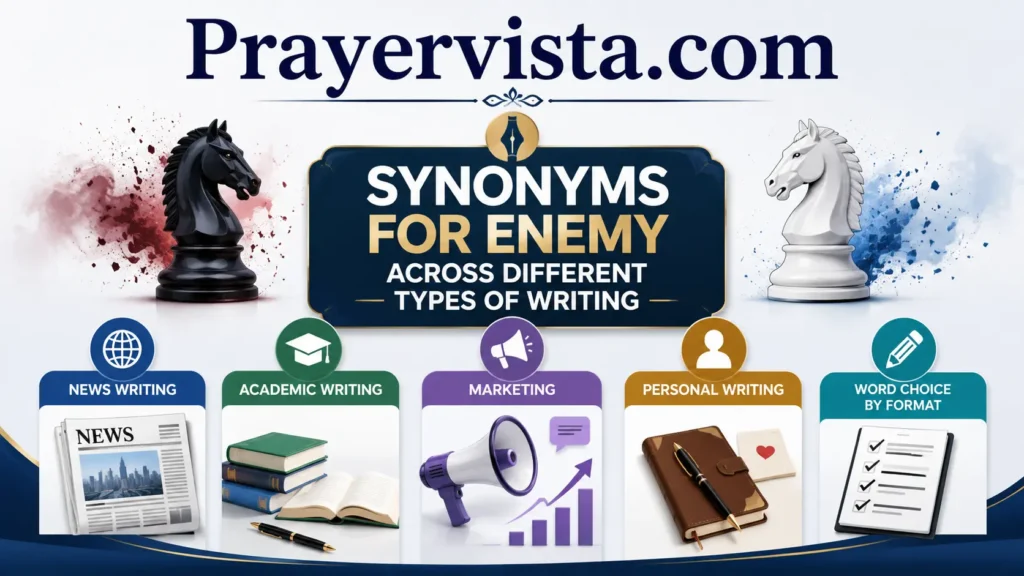
The right word shifts depending on where it’s going to live.
News writing leans on terms like “opposing faction” or “aggressor” carefully, because word choice there shapes how readers assign blame and severity. This is exactly why editors scrutinize this kind of language before publishing.
Academic writing prefers neutral terms: “opposing viewpoint,” “counterargument,” “dissenting party.” Nothing emotional, just precise.
Marketing rarely names an “enemy” outright. Brands usually frame competition around a shared challenge instead of pointing at a specific rival. It keeps the tone positive while still creating contrast.
Personal writing, journals, memoirs, reflective essays, has more room to be honest about intensity. “Tormentor,” “persecutor,” “old rival” all fit here, because the goal is emotional truth, not public neutrality.
Knowing which bucket you’re writing in before picking a word saves you from two common mistakes: sounding melodramatic in professional writing, or sounding flat in personal writing that actually needs some weight behind it.
Frequently Asked Questions
What are synonyms of enemy?
Common synonyms of enemy include foe, adversary, rival, opponent, antagonist, nemesis, and aggressor. The best choice depends on context, a courtroom needs “adversary,” a sports match needs “opponent,” and a war needs something closer to “aggressor” or “hostile force.”
Is enemy a strong word?
Yes, “enemy” is a strong word by default. It implies active hostility, and often something ongoing or personal, which is why using it for minor disagreements or everyday competition tends to sound exaggerated.
What are slang words for enemy?
Casual or slang alternatives include hater, frenemy, and troublemaker. These fit everyday conversation and social writing far better than formal terms like “adversary” or “belligerent,” which would sound out of place in a casual context.
Another word for enemy in war?
In military and wartime contexts, “enemy combatant,” “hostile force,” “aggressor,” and “belligerent” are the standard terms. These words carry the formality and precision expected in news reporting, treaties, and official military language.
What is a stronger word than enemy?
“Nemesis,” “archenemy,” “aggressor,” and “oppressor” all carry more intensity. Save them for situations with real stakes: serious harm, long term hostility, that kind of thing.
What is a polite word for enemy?
“Opponent,” “rival,” or “competitor.” All three describe opposition without implying personal hostility, which makes them safe for business, sports, or formal writing.
What do you call an enemy in a story?
Usually “villain,” “antagonist,” or “archenemy.” The exact word depends on how central and threatening the character is to the plot.
Is “adversary” the same as “enemy”?
Close, but not identical. “Adversary” is more formal and less emotionally loaded, which is why it’s common in legal, political, and competitive writing where hostility exists without personal animosity.
Synonyms vs. Antonyms for Enemy
Knowing the opposite of a word sharpens how precisely you use the original.
| Synonym | Antonym |
| Foe | Friend |
| Adversary | Ally |
| Rival | Partner |
| Aggressor | Protector |
| Opponent | Supporter |
Keeping these pairs straight matters most in longer pieces, where relationships between characters or companies can shift over time. You don’t want to accidentally call an ally an adversary three paragraphs later.
Practice Exercise: Test Your Synonym Skills
Reading a list of words is one thing. Using them naturally is another. This short exercise is built to help you practice choosing the right synonyms for enemy based on context, the same way you’d need to in real writing.
Read each sentence below and pick the best replacement for the word “enemy” from the options provided. Try to answer before checking the response underneath.
1. “The two companies have been enemies in the smartphone market for years.”
Options: Rival, Villain, Traitor
Best answer: Rival. This is business competition, not personal hostility, so a milder word fits better.
2. “After years of betraying his allies, he was finally exposed as the kingdom’s enemy.”
Options: Opponent, Traitor, Critic
Best answer: Traitor. The sentence specifically mentions betrayal, which “traitor” captures far more precisely than a generic word.
3. “She shook hands with her enemy after losing the final match.”
Options: Opponent, Aggressor, Persecutor
Best answer: Opponent. This is a sports context with no real hostility implied, so the neutral option works best.
4. “The report described the group as a serious enemy to national security.”
Options: Hater, Threat actor, Sore loser
Best answer: Threat actor. This is a formal, security-related context, and the term matches that register exactly.
5. “My coworker isn’t really an enemy, she’s just annoying sometimes.”
Options: Nuisance, Nemesis, Insurgent
Best answer: Nuisance. The sentence itself downplays the conflict, so the mildest option on the list is the right fit.
Try building three or four sentences of your own using different synonyms for enemy from the categories covered earlier in this guide. The goal isn’t memorization. It’s training your instinct to match intensity, tone, and setting every time the word “enemy” tempts you to use it as a shortcut.
Conclusion
“The enemy is anyone who tells you that you cannot do what you know in your heart you were meant to do,” wrote Steven Pressfield in The War of Art. It’s a good reminder that “enemy” isn’t always someone standing across from you, and that the language around conflict deserves the same care as any other word that matters.
This guide covered more than fifty synonyms for enemy, sorted by tone, formality, and context, from the weight of “nemesis” to the lightness of “frenemy.” None of them are interchangeable with the plain word by default, and that’s the point.
The real skill isn’t memorizing the list. It’s pausing long enough to ask what kind of opposition you’re actually describing before you commit to a word. A rival isn’t an aggressor. A critic isn’t a villain. Getting that right protects both the reader’s understanding and your own credibility.
As writing keeps evolving across journalism, business, and everyday communication, the demand for accurate, non-inflammatory language isn’t going away. Readers notice when a word oversells a situation, and they trust writing more when it doesn’t.
So next time “enemy” shows up in a draft, stop for a second. Ask what word from this list of synonyms for enemy would actually say it better. Do that enough times, and it stops being a rule you follow; it just becomes how you write.
More Useful Articles…..
- Synonyms for Good Examples : A Guide to Enriching Vocabulary
- Easy Synonyms for Light Examples in Daily English Writing

Hi, I’m Sophia Reynolds, a content writer at Prayervista.com. I love writing clear and engaging content about synonyms and vocabulary. My goal is to help readers understand word meanings, improve their English, and choose the right words with confidence through simple and accurate explanations.