Quick Summary
Synonyms for interesting quiz tests how many alternate words you know for “interesting.” This guide gives you a full list of synonyms. It covers formal words, slang words, and words for describing people. It also includes quiz questions, common mistakes, and a fun brain test at the end. You will also find comparison tables, collocations, idioms, and real FAQs. Every section uses short, simple sentences so the guide stays easy to follow from start to finish. By the end, you will never feel stuck using “interesting” again.
Introduction
Interesting means something that grabs your attention. It means something that makes you want to know more. This is why synonyms for interesting quiz help so many learners. It tests real vocabulary knowledge in a fun way. It also shows you where your gaps are.
Most students overuse the word “interesting.” They use it in essays and they use it in speech. They use it in daily chat too. This repetition makes writing feel flat. It also makes speech sound less confident. A good synonyms for interesting quiz helps break this habit. It pushes you to learn new words and test them right away.
This guide is more than a simple word list. It explains the meaning clearly and it gives short, easy examples. It also builds real synonyms for interesting quiz you can try yourself. You will test your memory. You will check your answers too. This active practice helps words stick faster than passive reading alone.
Vocabulary matters in real life. Strong word choice helps in school. It helps in job interviews. It helps in daily conversation too. Even small talk sounds better with fresh words. Learning synonyms for “interesting” is a small step. But it makes a big difference in how you sound to others.
This guide follows a simple path. First, you’ll try short quizzes. Then, you’ll study the full word list. After that, you’ll review common mistakes. Finally, you’ll test yourself one more time with a brain test before wrapping up with some final tips.
Table of Contents
- Introduction
- Synonyms for Interesting Quiz with Answers
- Synonyms for Interesting Quiz Questions
- Another Word for Interesting in an Essay
- Another Word for Interesting Person
- Very Interesting Synonym
- List of 50 Synonyms for Interesting with Categories
- Real-Life Examples of These Synonyms
- Common Collocations with Interesting
- Idioms and Phrases Related to Interesting
- Common Mistakes and Context Differences
- Brain Test for Interesting Synonyms
- FAQs
- Final Thoughts
Synonyms for Interesting Quiz with Answers
A good synonyms for interesting quiz with answers helps you learn fast. You answer a question. Then you check the answer right away. This builds memory quickly.
Try this short quiz:
Q1: Which word means “very interesting” in a strong way? A) Boring B) Riveting C) Plain D) Dull Answer: B) Riveting
Q2: Which word fits a formal essay best? A) Dope B) Cool C) Compelling D) Lit Answer: C) Compelling
Q3: Which word describes an interesting person? A) Charismatic B) Tired C) Slow D) Quiet Answer: A) Charismatic
Q4: Which word means “makes you think deeply”? A) Dull B) Thought-provoking C) Plain D) Flat Answer: B) Thought-provoking
Q5: Which word fits a text message to a friend? A) Notable B) Illuminating C) Cool D) Compelling Answer: C) Cool
Q6: What is the opposite of “riveting”? A) Boring B) Gripping C) Exciting D) Fascinating Answer: A) Boring
Q7: Which word fits a museum brochure best? A) Dope B) Captivating C) Lit D) Wild Answer: B) Captivating
Q8: Which word describes a person who naturally draws others in? A) Tired B) Quiet C) Magnetic D) Plain Answer: C) Magnetic
This kind of quiz works well for classrooms. It also works for self-study. Short questions with quick answers keep learning simple and clear. Teachers can use this format in worksheets. Students can also use it for quick daily practice before an exam.
Comparison Table: Quiz-Friendly Synonyms
| Word | Meaning | Best Used In | Example Sentence | Antonym |
| Riveting | Extremely interesting | Reviews, stories | The finale was riveting. | Boring |
| Compelling | Strong and convincing | Essays, arguments | It was a compelling case. | Weak |
| Charismatic | Naturally charming | Describing people | She is a charismatic leader. | Dull |
| Fascinating | Deeply interesting | General writing | The topic was fascinating. | Tedious |
| Engaging | Holds attention well | Talks, presentations | The speaker was engaging. | Dry |
Another Word for Interesting in an Essay
Essays need strong, formal words. Casual words like “cool” do not fit academic writing.
Good essay-friendly words include:
- Compelling
- Thought-provoking
- Engaging
- Noteworthy
- Insightful
Example: “The study offers a thought-provoking look at climate change.”
These words sound polished. They also show strong vocabulary skills. Teachers often reward students who avoid repeating simple words like “interesting.”
Try mixing these words across a long essay. Do not use the same one twice in one paragraph. This keeps your writing fresh from the first line to the last.
Teachers often look for vocabulary range when grading essays. Using varied, accurate words shows real command of the language. It also makes your argument feel more convincing to the reader, since strong word choice often signals strong thinking behind it.
Another Word for Interesting Person

People often want a stronger word to describe someone with personality. “Interesting person” sounds plain. A better word adds color.
Try these instead:
- Charismatic
- Charming
- Magnetic
- Captivating
- Fascinating
Example: “Everyone loved her; she has such a magnetic personality.”
These words work well in bios, introductions, and everyday conversation. They paint a clearer picture of someone’s character.
Use these words in resumes and LinkedIn profiles too. A well-chosen word can make a short bio feel warm and memorable, instead of generic.
Think about the impression you want to leave. “Charismatic” suggests natural leadership. “Charming” suggests warmth and ease. “Magnetic” suggests people are drawn to that person without even knowing why. Picking the right one adds real personality to your writing.
Very Interesting Synonym
Sometimes “interesting” feels too weak. You need a stronger word to show real excitement.
Try these power words:
- Riveting
- Enthralling
- Gripping
- Spellbinding
- Mesmerizing
Example: “The trial testimony was absolutely riveting.”
These words show intensity. They work well in reviews, stories, and news writing. Use them when “interesting” simply is not strong enough.
Comparison Table: Intensity Synonyms
| Word | Meaning | Tone | Example Sentence | Antonym |
| Riveting | Extremely interesting | Strong | The match was riveting. | Boring |
| Enthralling | Deeply fascinating | Strong | An enthralling performance. | Dull |
| Gripping | Holds attention tightly | Strong | A gripping thriller. | Tedious |
| Spellbinding | Holds like magic | Very strong | A spellbinding speech. | Monotonous |
| Mesmerizing | Deeply captivating | Very strong | A mesmerizing dance. | Uninteresting |
These words are best saved for truly powerful moments. Using them too often weakens their impact. Save “spellbinding” or “mesmerizing” for the one story, speech, or scene that truly deserves it.
Interesting in Daily Conversation
“Interesting” is one of the most commonly used words in everyday spoken English. People use it to react to stories, news, opinions, or experiences shared by others.
- Used as a quick, polite reaction when someone shares information (“That’s interesting!”)
- Helps keep conversations flowing without requiring a long response
- Common in casual chats, texting, and small talk with friends or family
- Can express genuine curiosity or mild surprise depending on tone
- Sometimes used diplomatically when a person doesn’t want to give a strong opinion
Interesting in Professional and Office Communication

In workplace settings, “interesting” plays a subtle but important role in emails, meetings, and presentations.
- Used to acknowledge an idea before giving feedback (“That’s an interesting proposal, but…”)
- Helps soften criticism in a professional and respectful way
- Common in performance reviews, brainstorming sessions, and client meetings
- Signals engagement without committing to full agreement
- Frequently appears in emails responding to reports, pitches, or data findings
Interesting in Academic and Formal Writing
Academic and formal writing also relies on “interesting,” though it requires more precision than casual speech.
- Used to highlight the significance of a finding or argument in essays and research papers
- Helps introduce a topic worth further exploration (“An interesting aspect of this study is…”)
- Overuse is discouraged in formal writing since it can sound vague or unspecific
- Often replaced with stronger academic vocabulary for higher-quality writing
- Useful when transitioning between sections of a report or thesis
How Important Is the Word “Interesting”?

“Interesting” holds real importance because it’s a flexible, all-purpose word that fits almost any context.
- Acts as a bridge word connecting reactions, opinions, and further discussion
- Easy to use correctly, making it accessible even for English learners
- Helps maintain politeness and engagement in conversations
- Its importance grows in communication where tone and diplomacy matter
- Despite its usefulness, relying on it too much can make speech or writing sound repetitive
Why Should You Know Synonyms for Interesting?
Knowing alternatives to “interesting” improves the quality and impact of communication.
- Prevents repetitive language in essays, articles, and conversations
- Allows more precise expression of emotions (e.g., “fascinating,” “intriguing,” “captivating”)
- Strengthens vocabulary for exams, interviews, and professional writing
- Makes speech and writing sound more confident and articulate
- Helps writers match tone — a stronger word can add emphasis where “interesting” feels flat
How Often Is “Interesting” Searched?
“Interesting” and its synonyms are frequently searched online, especially by students, writers, and English learners.
- Common searches include “synonyms for interesting,” “another word for interesting,” and “interesting meaning”
- High search volume reflects the word’s daily-use frequency in English
- Popular among ESL (English as a Second Language) learners looking to expand vocabulary
- Frequently searched alongside essay-writing and vocabulary-building tools
- Search trends tend to spike during academic seasons (exams, assignments, application essays)
How Popular Is the Word “Interesting”?

“Interesting” ranks among the most widely used adjectives in the English language.
- Frequently appears in the top vocabulary lists for intermediate and advanced English learners
- Common in books, news articles, advertisements, and everyday speech
- Popular in both spoken and written English across different English-speaking countries
- Widely taught early in English language courses due to its versatility
- Its popularity comes from being simple, universally understood, and easy to pronounce
How Common Is the Word “Interesting”?
“Interesting” is considered a high-frequency word in the English language.
- Appears regularly in casual conversations, media, and formal documents alike
- Ranked among commonly used adjectives in major English frequency word lists
- Used across all age groups and proficiency levels
- Its commonality sometimes leads to overuse, making synonyms valuable for variety
- Found in nearly every genre of writing — from fiction to business reports
Common Synonyms for “Interesting”
Expanding your vocabulary with alternatives helps you express different shades of meaning.
- Fascinating – for something that captures deep attention
- Intriguing – for something mysterious or thought-provoking
- Engaging – for content that holds attention actively
- Captivating – for something charming or spellbinding
- Compelling – for something persuasive or hard to ignore
Common Antonyms for “Interesting”
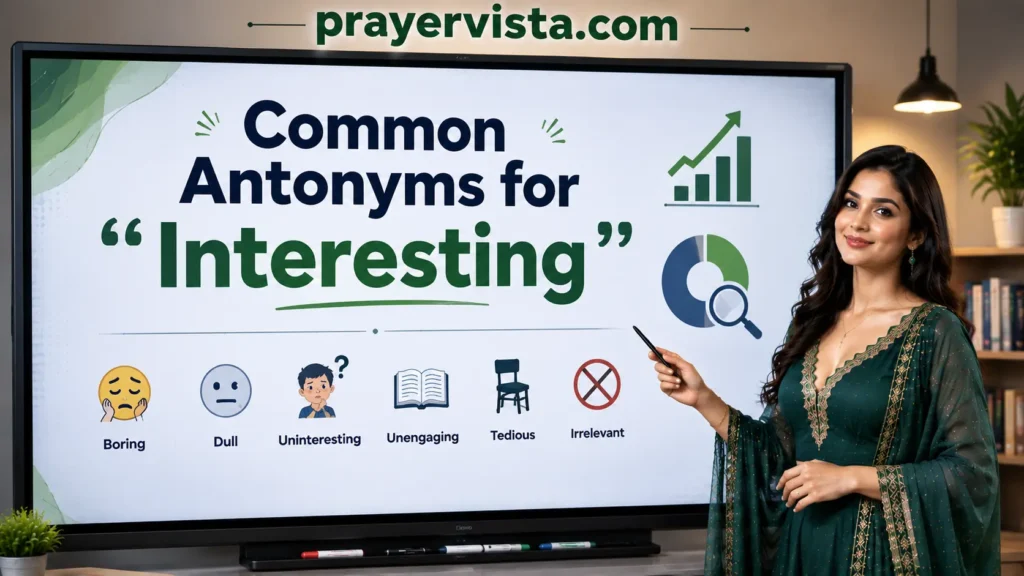
Understanding opposite words helps balance vocabulary and improve descriptive accuracy.
- Boring – lacking any excitement or appeal
- Dull – flat, uninteresting, or monotonous
- Tedious – long, tiresome, and repetitive
- Uninspiring – failing to spark enthusiasm or motivation
- Monotonous – repetitive and lacking variety
Tips to Avoid Overusing “Interesting”
Since “interesting” is so common, writers and speakers should use it thoughtfully.
- Replace it with a more specific synonym when possible for stronger impact
- Use it sparingly in academic writing to maintain a formal tone
- Combine it with details instead of using it alone (“interesting because…”)
- Reserve strong synonyms like “fascinating” or “captivating” for truly notable content
- Read your writing aloud to check if the word is repeated too often
List of 50 Synonyms for Interesting Quiz
Here is a full list of 50 fresh synonyms. Each one includes a short meaning and example. This list covers formal words, casual words, and slang. Keep it handy for essays, chats, and everyday writing.
Synonyms for Interesting That Spark Curiosity and Attention
1. Fascinating
Meaning: Very interesting.
Example: The museum tour was fascinating.
Example: It kept everyone asking questions.
2. Intriguing
Meaning: Sparks curiosity.
Example: Her plan sounded intriguing.
Example: Nobody could stop thinking about it.
3. Engaging
Meaning: Holds attention.
Example: The speaker was engaging.
Example: The whole room stayed focused.
4. Captivating
Meaning: Charms deeply.
Example: The view was captivating.
Example: Visitors stopped to take photos.
5. Compelling
Meaning: Convincing and strong.
Example: It was a compelling argument.
Example: Even the judges agreed.
| No. | Synonym | Meaning | Example | Type |
| 1 | Fascinating | Very interesting | The museum tour was fascinating. | Strong |
| 2 | Intriguing | Sparks curiosity | Her plan sounded intriguing. | Curiosity |
| 3 | Engaging | Holds attention | The speaker was engaging. | Attention |
| 4 | Captivating | Charms deeply | The view was captivating. | Strong |
| 5 | Compelling | Convincing and strong | It was a compelling argument. | Powerful |
6. Absorbing
Meaning: Fully takes attention.
Example: The novel was absorbing.
Example: She finished it in one night.
7. Riveting
Meaning: Extremely interesting.
Example: The match was riveting.
Example: Fans stayed until the last second.
8. Gripping
Meaning: Holds you tightly.
Example: It was a gripping story.
Example: Readers could not put it down.
9. Thought-provoking
Meaning: Makes you think.
Example: A thought-provoking film.
Example: It sparked debate for days.
10. Stimulating
Meaning: Sparks the mind.
Example: A stimulating debate.
Example: Students left with new ideas.
11. Enthralling
Meaning: Deeply fascinating.
Example: An enthralling performance.
Example: The crowd stood in silence.
12. Entertaining
Meaning: Fun and enjoyable.
Example: An entertaining show.
Example: Everyone left with a smile.
13. Appealing
Meaning: Attractive to interest.
Example: An appealing idea.
Example: The whole team liked it fast.
14. Curious
Meaning: Odd yet interesting.
Example: A curious detail.
Example: It made the case more complex.
15. Remarkable
Meaning: Worth noticing.
Example: A remarkable discovery.
Example: Scientists called it a breakthrough.
Synonyms for Interesting That Show Attraction and Excitement

16. Notable
Meaning: Important enough to note.
Example: A notable achievement.
Example: It earned him an award.
17. Noteworthy
Meaning: Deserves attention.
Example: A noteworthy result.
Example: The board praised the team.
18. Engrossing
Meaning: Deeply absorbing.
Example: An engrossing documentary.
Example: Viewers forgot the time.
19. Spellbinding
Meaning: Holds like magic.
Example: A spellbinding tale.
Example: Children sat wide-eyed for an hour.
20. Mesmerizing
Meaning: Deeply captivating.
Example: A mesmerizing dance.
Example: No one looked away.
| No. | Synonym | Meaning | Example | Type |
| 16 | Notable | Important enough to note | A notable achievement. | Important |
| 17 | Noteworthy | Deserves attention | A noteworthy result. | Attention |
| 18 | Engrossing | Deeply absorbing | An engrossing documentary. | Absorbing |
| 19 | Spellbinding | Holds like magic | A spellbinding tale. | Captivating |
| 20 | Mesmerizing | Deeply captivating | A mesmerizing dance. | Captivating |
21. Enchanting
Meaning: Charming and magical.
Example: An enchanting garden.
Example: Guests wanted to stay forever.
22. Alluring
Meaning: Attractively interesting.
Example: An alluring offer.
Example: It was hard to refuse.
23. Provocative
Meaning: Sparks strong reaction.
Example: A provocative topic.
Example: It divided the whole room.
24. Exciting
Meaning: Full of energy.
Example: An exciting match.
Example: Fans jumped from their seats.
25. Amusing
Meaning: Light and fun.
Example: An amusing story.
Example: Everyone laughed out loud.
26. Diverting
Meaning: Pleasantly distracting.
Example: A diverting hobby.
Example: It helped him relax after work.
27. Arresting
Meaning: Grabs attention fast.
Example: An arresting image.
Example: It went viral within hours.
28. Striking
Meaning: Bold and noticeable.
Example: A striking design.
Example: Customers noticed it right away.
29. Novel
Meaning: New and unusual.
Example: A novel approach.
Example: Experts praised its fresh thinking.
30. Unusual
Meaning: Different from normal.
Example: An unusual case.
Example: Doctors had never seen it before.
Synonyms for Interesting That Express Uniqueness and Admiration

31. Unique
Meaning: One of a kind.
Example: A unique style.
Example: No other artist copied it.
32. Extraordinary
Meaning: Beyond ordinary.
Example: An extraordinary talent.
Example: Coaches noticed her right away.
33. Exceptional
Meaning: Very rare and good.
Example: An exceptional performance.
Example: Critics gave it top marks.
34. Impressive
Meaning: Earns admiration.
Example: An impressive score.
Example: Teachers were genuinely surprised.
35. Delightful
Meaning: Pleasing and nice.
Example: A delightful surprise.
Example: Guests thanked the host twice.
| No. | Synonym | Meaning | Example | Type |
| 31 | Unique | One of a kind | A unique style. | Special |
| 32 | Extraordinary | Beyond ordinary | An extraordinary talent. | Exceptional |
| 33 | Exceptional | Very rare and good | An exceptional performance. | Excellent |
| 34 | Impressive | Earns admiration | An impressive score. | Admiration |
| 35 | Delightful | Pleasing and nice | A delightful surprise. | Pleasant |
36. Illuminating
Meaning: Adds new understanding.
Example: An illuminating talk.
Example: Attendees left with clear answers.
37. Insightful
Meaning: Shows deep understanding.
Example: An insightful comment.
Example: It changed the whole discussion.
38. Informative
Meaning: Full of useful facts.
Example: An informative article.
Example: Readers shared it widely.
39. Eye-opening
Meaning: Reveals new truth.
Example: An eye-opening report.
Example: It changed company policy.
40. Revealing
Meaning: Shows hidden facts.
Example: A revealing interview.
Example: Fans finally got real answers.
41. Vivid
Meaning: Bright and clear.
Example: A vivid memory.
Example: She could describe every detail.
42. Colorful
Meaning: Full of variety.
Example: A colorful character.
Example: Everyone remembered his stories.
43. Dynamic
Meaning: Full of energy and change.
Example: A dynamic speaker.
Example: The audience stayed alert.
44. Lively
Meaning: Active and full of life.
Example: A lively discussion.
Example: Ideas kept flowing fast.
45. Charismatic
Meaning: Naturally charming.
Example: A charismatic leader.
Example: Employees trusted him instantly.
46. Charming
Meaning: Pleasant and likable.
Example: A charming host.
Example: Guests felt welcome right away.
47. Magnetic
Meaning: Draws people in.
Example: A magnetic personality.
Example: People wanted to know her more.
48. Cool
Meaning: Casual word for interesting.
Example: That’s so cool!
Example: Friends use it every day.
49. Awesome
Meaning: Casual, strong praise.
Example: That trip was awesome.
Example: It became her favorite memory.
50. Dope
Meaning: Slang for very interesting.
Example: This song is dope.
Example: Fans played it on repeat.
Real-Life Examples of These Synonyms

Seeing these words in full sentences helps you understand how they work naturally in different situations.
The teacher praised the student’s insightful questions during the science discussion.
The students found the science lesson fascinating because the teacher included real volcanic experiments.
During the interview, the hiring manager considered the candidate’s solution novel and practical.
The unexpected ending made the entire film gripping from start to finish.
You should watch that new series because the storyline is seriously dope.
Everyone agreed that her proposal was compelling and worth funding.
Visitors often describe the old city as enchanting after exploring its narrow streets.
The latest episode shares a remarkable story about a forgotten invention.
Notice how the tone changes with each setting. Formal spaces need formal words. Casual chats allow slang. Matching tone to setting is the real skill behind strong vocabulary.
Common Collocations with Interesting
Collocations are natural word pairs. Learning them helps you sound more fluent.
- Mildly interesting – somewhat interesting, not very strong
- Deeply interesting – strongly interesting, holds full attention
- Interesting fact – a fun or useful piece of information
- Interesting perspective – a fresh or unusual point of view
- Sounds interesting – a common casual response to an idea
Example: “That’s an interesting perspective, I hadn’t thought of it that way.”
Idioms and Phrases Related to Interesting
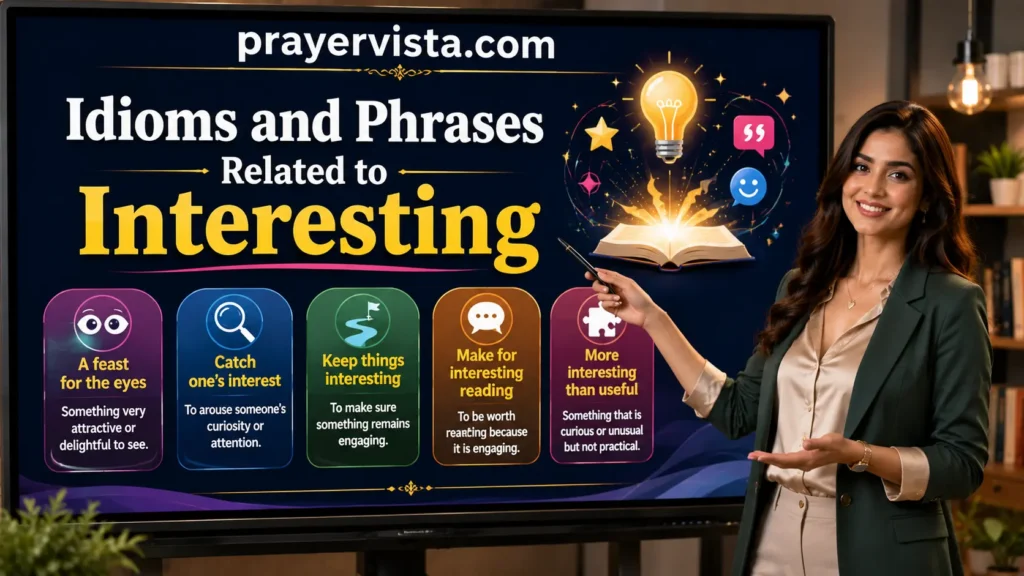
A few idioms connect closely to the idea of interest and attention.
- Food for thought – something that makes you think deeply
- Catch someone’s eye – to attract attention or interest
- Hold someone’s attention – to keep someone interested
- A page-turner – a book so interesting you cannot stop reading
Example: “The report gave the board plenty of food for thought.”
These phrases add color to everyday speech. Practice using one in a sentence today. It will start to feel natural after just a few tries. Native speakers use idioms without even thinking, so learning even a handful will make your English sound noticeably smoother.
Try writing five sentences using these idioms this week. Read them aloud to a friend or record yourself. Hearing your own voice use new phrases builds real confidence over time.
Common Mistakes and Context Differences
Many learners misuse these synonyms. Context always matters. A word that sounds perfect in one sentence can feel completely wrong in another. Here are the most common mistakes.
Comparison Table: Formal vs. Informal Synonyms
| Word | Meaning | Formal/Informal | Example Sentence | Antonym |
| Compelling | Strong and convincing | Formal | It was a compelling report. | Weak |
| Noteworthy | Deserves attention | Formal | A noteworthy discovery. | Ordinary |
| Cool | Casual for interesting | Informal | That’s so cool. | weak |
| Lit | Slang for exciting | Informal | The party was lit. | Boring |
| Insightful | Shows deep understanding | Formal | An insightful review. | Shallow |
Mistake 1: Using slang in formal writing. Words like “dope” or “cool” do not belong in essays. They can make a serious paper feel unprofessional, even if the idea behind it is strong.
Mistake 2: Mixing up “curious” and “curious about.” As an adjective for a thing, “curious” means odd. As a feeling, it means eager to know. Context tells the difference, so always check which meaning fits your sentence.
Mistake 3: Overusing “amazing” for everything. Reserve stronger words like “riveting” or “enthralling” for truly powerful moments. If everything is “amazing,” nothing feels special anymore.
Mistake 4: Confusing “interesting” with “interested.” “Interesting” describes a thing. “Interested” describes a feeling. Example: “The book is interesting” versus “I am interested in the book.” Mixing these up is one of the most common English errors worldwide.
Mistake 5: Using intense words for mild situations. “Spellbinding” fits a dramatic story. It does not fit a boring meeting that was just “okay.” Save the strongest words for moments that truly deserve them.
Mistake 6: Repeating the same synonym too often. Even a strong word like “fascinating” loses its power if used five times in one page. Aim to use each synonym only once or twice per document.
Understanding context helps you pick the right word every time. Always match word strength to the real situation.
Brain Test for Interesting Synonyms
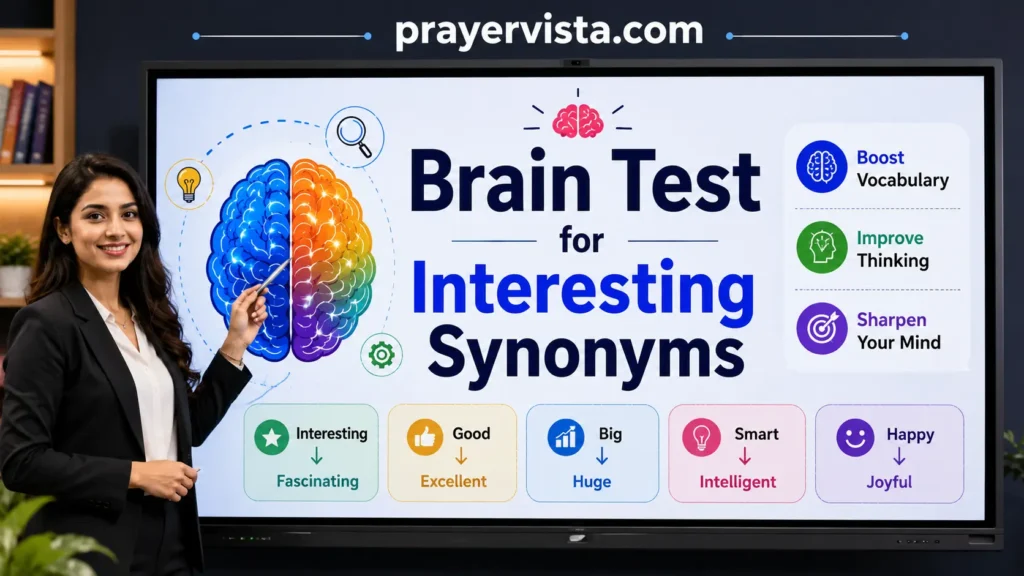
Try this quick brain test. It has four parts. Answer each one before checking the answers below.
Multiple Choice Questions
- Which word means “deeply fascinating”?
A) Boring B) Enthralling C) Plain D) Slow
Answer: B) Enthralling - Which word describes a person with strong charm?
A) Charismatic B) Tired C) Quiet D) Dull
Answer: A) Charismatic - Which word best fits a formal essay?
A) Cool B) Dope C) Compelling D) Lit
Answer: C) Compelling - Which word is casual slang for “interesting”?
A) Noteworthy B) Dope C) Insightful D) Illuminating
Answer: B) Dope
Fill in the Blanks
- The professor gave a very _______ lecture on space travel. (Insightful)
- The movie plot was so _______ that no one left their seat. (Gripping)
- Her speech was _______, and the crowd stood to applaud. (Enthralling)
- That new song is so _______, everyone keeps replaying it. (Dope)
Match the Columns
| Column A | Column B |
| 1. Riveting | a. Naturally charming |
| 2. Charismatic | b. Extremely interesting |
| 3. Noteworthy | c. Slang for exciting |
| 4. Lit | d. Deserves attention |
Answers: 1-b, 2-a, 3-d, 4-c
Part 4: True or False
- “Notable” and “boring” are synonyms. (False)
- “Fascinating” and “dull” are antonyms. (True)
- “Compelling” fits well in a formal report. (True)
- “Dope” is a good word choice for a school essay. (False)
If you get most of these right, your vocabulary is strong. If not, review the list above and try again tomorrow. Repeating this test after a week helps lock the words into long-term memory.
Short daily brain tests work better than one long study session. Even five minutes a day can build strong vocabulary within a month. Try writing your own quiz questions too. Teaching a word to someone else is one of the fastest ways to remember it forever.
FAQs
What are interesting synonyms?
Interesting synonyms include fascinating, engaging, captivating, and intriguing. Each word carries a slightly different level of intensity and tone. Choosing the right one depends on your audience and setting. A children’s book and a research paper need very different word choices. Learning several options helps you avoid repeating the same word.
What is an interesting synonym for a slang word?
Common slang choices include dope, cool, lit, and wild. These fit casual talk but not formal writing. Save them for texts, social media, or chats with friends. They can sound out of place in professional settings. Always check your audience before using them.
What are interesting antonyms?
Common interesting antonyms include boring, dull, tedious, monotonous, and uninteresting. These describe the exact opposite feeling. They often describe a slow class or a flat conversation. Knowing antonyms helps you understand the full range of the word’s meaning. It also helps you spot contrast in writing.
What are 5 synonyms for interesting?
Five strong choices are fascinating, engaging, captivating, riveting, and compelling. Each fits slightly different situations. Some work best in casual writing. Others fit strong, formal essays. Practicing all five in your own sentences helps you learn when to use each one.
How do you say “very interesting” in English?
Use words like riveting, enthralling, gripping, or spellbinding. These show strong excitement or attention. They are much stronger than the plain word “interesting.” They work best for truly standout moments. Save them for stories, reviews, or big highlights.
Is “interesting” a formal word?
Yes, “interesting” is neutral. It works in both casual and formal writing. But repeating it too often weakens your writing. Mixing in synonyms is always a good habit. This matters most in essays and reports.
Why should I avoid repeating “interesting” too much?
Repeated words feel flat and lazy to readers. Synonyms keep your writing fresh. They also show a wider vocabulary. This impresses teachers, readers, and employers alike. Strong word variety is one of the easiest ways to improve any piece of writing.
What is the best synonym for “interesting” in a job interview?
“Compelling” or “insightful” work well in interviews. They sound confident and professional. They do not feel too casual or too dramatic for the setting. Using them shows strong communication skills. They also help you stand out from other candidates.
Can I use “interesting” and its synonyms interchangeably?
Not always. Each synonym carries its own shade of meaning. “Riveting” is much stronger than “mildly interesting.” Always check the context before swapping one word for another. A small change in word choice can shift the whole tone of a sentence.
What is a good synonym for a “very interesting person”?
Charismatic and magnetic work well for a very interesting person. Both words describe someone whose presence naturally draws people in. They sound warm without feeling too casual. Use them in bios, introductions, or everyday conversation.
What is the difference between “fascinating” and “interesting”?
“Fascinating” is stronger than “interesting.” Something interesting simply holds your attention. Something fascinating grabs it completely. It also makes you want to learn more right away. The difference lies mostly in intensity.
What is a one-word synonym for interesting?
Simple one-word options include fascinating, engaging, compelling, or riveting. Pick the one that best matches your sentence’s tone. Formal writing favors “compelling” or “noteworthy.” Casual writing favors “cool” or “fun.”
What is the British English word for interesting?
British English often uses brilliant or fascinating in casual conversation. Formal British writing still favors words like “compelling” and “noteworthy.” These overlap closely with American English. The biggest differences show up mostly in slang.
What is a fun synonym for interesting for kids?
Simple, kid-friendly words include cool, fun, and amazing. These are easy to understand. They fit school projects, storybooks, and everyday classroom talk. Simple words help young learners build confidence early.
What is the strongest synonym for interesting?
Spellbinding and mesmerizing are among the strongest choices. These words describe something so interesting that it fully holds a person’s attention. They work best for truly powerful moments. Avoid using them for everyday, ordinary situations.
What is another word for “not very interesting”?
Try mildly interesting, so-so, or unremarkable. These softer terms describe something that has a little interest. They do not truly stand out, though. They work well for honest, neutral reviews and feedback.
Final Thoughts
Synonyms for interesting quiz is a fun way to grow your vocabulary. You learned formal words for essays. You learned slang for casual chat and you also learned strong words for real excitement and you even learned collocations and idioms that native speakers use every day.
Practice makes these words stick. Try one new word each day. Use it in a sentence. Say it out loud too. Small daily habits build strong, lasting vocabulary over time. Writing the word down, saying it, and hearing it all help your brain remember it faster.
Quizzes make learning active instead of passive. Reading a list is helpful, but testing yourself is far more powerful. Use the brain test above whenever you need a quick refresher. You can also turn this list into flashcards for extra practice on the go.
Vocabulary building never really ends. Even advanced English speakers keep learning new words their whole lives. The goal is not to memorize every synonym at once. The goal is to slowly build a natural feel for which word fits which moment.
Come back to this guide anytime “interesting” feels too plain. Pick the right word for your tone and audience. Your writing and speech will feel fresh, sharp, and far more engaging every single time you use it. And whenever you want to test yourself again, these synonyms for interesting quiz will be right here waiting for you.
Explore More In-Depth Articles…..
- Synonyms for Good Examples : A Guide to Enriching Vocabulary
- Easy Synonyms for Light Examples in Daily English Writing
- Synonyms for Enemy: 50+ Alternatives to Use in Every Context
- Synonyms for However Quiz: The Complete Guide with Examples

Hi, I’m Sophia Reynolds, a content writer at Prayervista.com. I love writing clear and engaging content about synonyms and vocabulary. My goal is to help readers understand word meanings, improve their English, and choose the right words with confidence through simple and accurate explanations.