Quick Summary
Small means not large. English has many synonyms for small. Little is common in daily English. Tiny means very small. Miniature means a small copy. Slight means a small change. Minor means less important. Compact means small and easy to carry. Diminutive means noticeably small. Minuscule means extremely small. Modest means not large. Petite means small and delicate. Minute means extremely small. Minimal means very little.
This guide covers 50+ synonyms for small. It includes meanings and easy examples. You will learn how to use each word. The examples are simple and clear. Some words are useful for formal writing. Others work well in daily English. You can also find words for IELTS and casual use.
Introduction
Synonyms for small examples show different ways to use the word small. The word small means not large. It can describe size, amount, or degree. English has many useful alternatives for this word. Each synonym has a slightly different meaning. Little is common in everyday English. Tiny means very small. Miniature means a small copy of something. Slight often describes a small change. Minor can describe something that is not very important.
Choosing the right synonym can improve your writing. It can make your sentences more natural. It can also help you avoid repeating the word small. Good word choice makes your meaning clearer. These words are useful in many situations. You can use them in school assignments. They can also help with IELTS writing. Some words are better for formal writing. Others are better for casual conversations.
In this guide, you will learn synonyms for small examples with easy sentences. You will also learn words for small sizes and very small amounts. Formal and funny alternatives are included too. The examples will help you understand each word. You can learn these words through simple examples. This makes them easier to remember and use. You can also choose the best synonym for each situation.
Another useful point is context. A word may fit one sentence but not another. For example, tiny works well for size. Slight works better for a change. Minor works better for a problem. Learning these differences helps you use English more naturally.
Synonyms for small examples sentences
The word small has many useful alternatives.
Each synonym has a different use.
Little is common in daily English.
Tiny means very small.
Slight describes a small change.
Minor describes something less important.
- Little — a little house
- Tiny — a tiny bird
- Miniature — a miniature car
- Slight — a slight change
- Minor — a minor problem
- Compact — a compact room
- Minuscule — a minuscule amount
Synonyms for small examples funny
Some synonyms for small sound funny or cute.
They are common in casual English.
These words can make sentences more playful.
They work well in friendly conversations.
They can also suit stories and captions.
Avoid them in formal academic writing.
- Teeny — a teeny toy
- Teensy — a teensy box
- Wee — a wee house
- Weeny — a weeny piece
- Bitty — a bitty puppy
- Dinky — a dinky car
- Itsy-bitsy — an itsy-bitsy insect
What is a synonym for “very small”?
There are many words for very small words.
Tiny is the easiest everyday choice.
Minute sounds more formal.
Minuscule means extremely small.
Microscopic is common in science.
Infinitesimal often describes very small amounts.
- Tiny — a tiny flower
- Minute — a minute detail
- Minuscule — a minuscule amount
- Microscopic — microscopic organisms
- Infinitesimal — an infinitesimal difference
- Diminutive — a diminutive figure
- Teeny — a teeny button
Another word for small things in life
Small things can mean simple objects.
They can also mean simple moments.
The best expression depends on the context.
Little things are very common.
Small joys sound warm and natural.
Simple pleasures can describe everyday happiness.
- Little things — little things in life
- Small joys — small joys every day
- Little moments — little moments with family
- Simple pleasures — simple pleasures of life
- Everyday moments — everyday moments matter
- Small details — small details can matter
- Little memories — little memories stay with us
Very small synonym formal
Formal English has several words for very small.
Minute is useful in academic writing.
Minuscule means extremely small.
Minimal means very little.
Negligible means too small to matter much.
Infinitesimal is useful for extremely small quantities.
- Minute — a minute difference
- Minuscule — a minuscule amount
- Minimal — minimal effort
- Negligible — negligible impact
- Infinitesimal — an infinitesimal change
- Diminutive — a diminutive figure
- Slight — a slight increase
Top List of 50+ Synonyms for Small
Synonyms for Small Size
1. Little
Meaning: Small in size.
Example: She carried a little purse.
2. Tiny
Meaning: Very small.
Example: A tiny frog jumped across the path.
3. Miniature
Meaning: A small copy of something.
Example: He displayed a miniature castle.
4. Diminutive
Meaning: Noticeably small.
Example: The diminutive statue stood on the desk.
5. Minute
Meaning: Extremely small.
Example: The camera captured a minute detail.
6. Minuscule
Meaning: Extremely small.
Example: A minuscule mark appeared on the page.
7. Microscopic
Meaning: Too small to see clearly.
Example: The scientist examined microscopic cells.
8. Petite
Meaning: Small and delicately built.
Example: The boutique offers petite jackets.
9. Compact
Meaning: Small and easy to fit.
Example: We bought a compact speaker.
10. Dainty
Meaning: Small and delicate.
Example: She placed a dainty flower in the vase.
11. Wee
Meaning: Very small.
Example: A wee kitten slept near the window.
12. Teeny
Meaning: Extremely small.
Example: He found a teeny button under the chair.
13. Teensy
Meaning: Very small.
Example: The artist painted a teensy star.
14. Weeny
Meaning: Very small.
Example: There was a weeny scratch on the table.
15. Bitty
Meaning: Very small.
Example: The child arranged bitty blocks on the floor.
16. Dinky
Meaning: Small and often cute.
Example: They played with a dinky toy train.
17. Undersized
Meaning: Smaller than the normal size.
Example: The undersized box could not hold the books.
Comparison Table
| # | Synonym | Meaning | Example | Usage | Antonym |
| 1 | Little | Small in size | She carried a little purse. | Everyday English | Large |
| 2 | Tiny | Very small | A tiny frog jumped away. | Common English | Huge |
| 3 | Miniature | A small copy | He displayed a miniature castle. | Models and copies | Full size |
| 4 | Compact | Small and practical | We bought a compact speaker. | Products and spaces | Bulky |
| 5 | Petite | Small and delicately built | The store sells petite jackets. | Clothing and people | Large |
| 6 | Dainty | Small and delicate | She wore a dainty bracelet. | Objects and details | Coarse |
Synonyms for Very Small Amount, Number, or Degree
18. Minuscule
Meaning: Extremely small.
Example: A minuscule insect crawled across the leaf.
19. Microscopic
Meaning: Too small to see easily.
Example: The scientist studied microscopic particles.
20. Diminutive
Meaning: Noticeably small.
Example: The diminutive plant grew beside the wall.
21. Wee
Meaning: Very small.
Example: They lived in a wee cottage.
22. Teeny
Meaning: Extremely small.
Example: She found a teeny shell near the beach.
23. Teensy
Meaning: Very small.
Example: A teensy button fell from the shirt.
24. Weeny
Meaning: Very small.
Example: There was a weeny crack in the cup.
25. Bitty
Meaning: Very small.
Example: The child collected bitty stones.
26. Dinky
Meaning: Small and often attractive.
Example: He bought a dinky little car.
27. Undersized
Meaning: Smaller than normal.
Example: The undersized helmet felt uncomfortable.
28. Negligible
Meaning: So small that it hardly matters.
Example: The change had a negligible effect.
29. Marginal
Meaning: Very small or limited.
Example: The plan produced marginal gains.
30. Modicum
Meaning: A small amount.
Example: He showed a modicum of interest.
31. Scanty
Meaning: Small in amount or supply.
Example: The region receives scanty rainfall.
32. Paltry
Meaning: Very small and disappointing.
Example: The worker received a paltry reward.
33. Sparse
Meaning: Small in number or amount.
Example: The island has sparse vegetation.
34. Inconsiderable
Meaning: Small or unimportant.
Example: The difference was inconsiderable.
Comparison Table
| # | Synonym | Meaning | Example | Usage | Antonym |
| 8 | Minuscule | Extremely small | A minuscule insect crawled across the leaf. | Formal | Huge |
| 9 | Microscopic | Too small to see easily | The scientist studied microscopic particles. | Scientific | Macroscopic |
| 10 | Diminutive | Noticeably small | The diminutive plant grew beside the wall. | Descriptive | Large |
| 11 | Wee | Very small | They lived in a wee cottage. | Informal | Huge |
| 12 | Teeny | Extremely small | She found a teeny shell near the beach. | Casual | Huge |
| 13 | Teensy | Very small | A teensy button fell from the shirt. | Casual | Large |
Synonyms for Small Importance, Effect, or Informal Use
35. Minor
Meaning: Not very important or serious.
Example: The mechanic fixed a minor fault.
36. Trivial
Meaning: Not important.
Example: They argued over a trivial issue.
37. Insignificant
Meaning: Not important or noticeable.
Example: The difference was insignificant.
38. Unimportant
Meaning: Having little importance.
Example: That detail is unimportant.
39. Inconsequential
Meaning: Having little effect.
Example: The mistake was inconsequential.
40. Subtle
Meaning: Small and hard to notice.
Example: The painting has a subtle color change.
41. Fine
Meaning: Very thin or delicate.
Example: The artist used a fine brush.
42. Narrow
Meaning: Small in width.
Example: They walked along a narrow street.
43. Slender
Meaning: Thin and narrow.
Example: A slender branch touched the window.
44. Smidgen
Meaning: A very small amount.
Example: Add a smidgen of pepper.
45. Tad
Meaning: A small amount.
Example: The soup needs a tad more salt.
46. Jot
Meaning: A very small amount.
Example: He did not have a jot of patience.
47. Scintilla
Meaning: A tiny amount or trace.
Example: There was not a scintilla of doubt.
48. Infinitesimal
Meaning: Extremely small.
Example: The device detected an infinitesimal change.
49. Petite
Meaning: Small and delicately built.
Example: The shop has a petite section.
50. Dainty
Meaning: Small and delicate.
Example: She chose a dainty necklace.
Comparison Table
| # | Synonym | Meaning | Example | Usage | Antonym |
| 14 | Minor | Not very important | The mechanic fixed a minor fault. | Problems | Major |
| 15 | Trivial | Not important | They discussed a trivial issue. | Matters | Serious |
| 16 | Insignificant | Not important or noticeable | The difference was insignificant. | Differences | Significant |
| 17 | Unimportant | Having little importance | That detail is unimportant. | General English | Important |
| 18 | Inconsequential | Having little effect | The mistake was inconsequential. | Formal | Consequential |
| 19 | Subtle | Small and hard to notice | The painting has a subtle change. | Details | Obvious |
Common Collocations with Small Synonyms
Collocations are words that naturally appear together. They help your English sound smooth. Small synonyms have their own common combinations. Learning these combinations is better than learning words alone. It also helps you choose the right synonym quickly.
For example, slight commonly appears with words such as difference, change, increase, and delay. The minority often appears with problems, mistakes, issues, and injury. Minimal works well with effort, cost, risk, and impact. Tiny is common with objects, details, pieces, and amounts.
Some useful collocations are:
- slight difference
Example: There is a slight difference between the two plans. - slight increase
Example: The price showed a slight increase. - minor mistake
Example: She made a minor mistake in the report. - minor issue
Example: The software has a minor issue. - minimal effort
Example: The task requires minimal effort. - minimal cost
Example: The project was completed at minimal cost. - tiny detail
Example: A tiny detail changed the whole picture. - tiny amount
Example: Only a tiny amount of paint was left. - compact design
Example: The phone has a compact design. - limited space
Example: We have limited space in the office.
These combinations are useful in school writing and everyday English. They are also helpful for IELTS vocabulary. However, don’t force a collocation into a sentence. Choose the word that matches the meaning.
Real-Life Examples of Hate Synonyms in Use
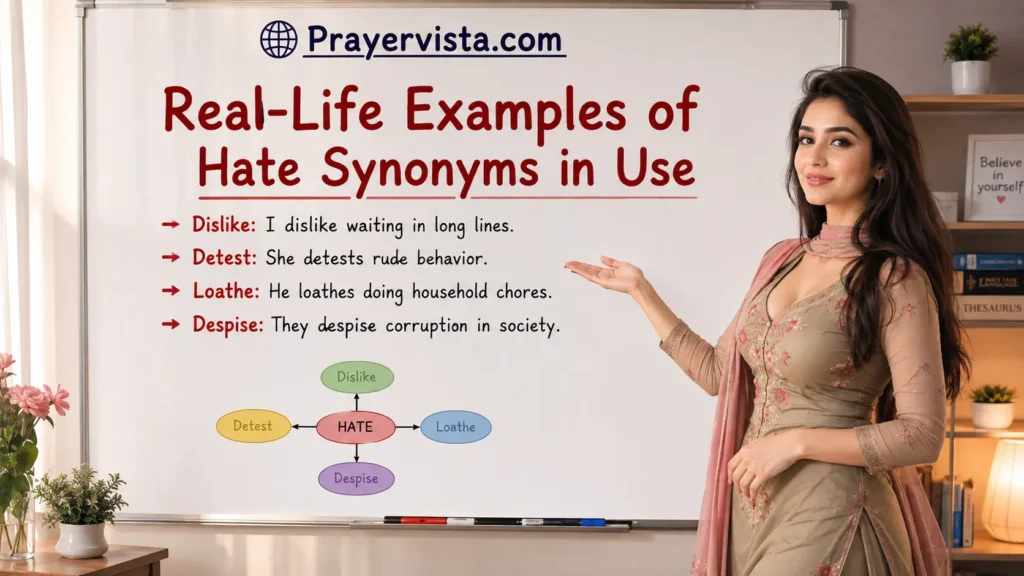
Real-life examples show how synonyms work in natural situations. A dictionary gives the meaning. An example shows the actual use. This difference is important for English learners. It helps you understand both meaning and context.
Imagine that a shop has very little space. You can say, “The shop has limited space.” The word limited sounds natural here. If a phone is small and easy to carry, compact is a better choice.
Different situations need different words:
- Tiny: A tiny button fell from my shirt.
- Slight: There was a slight delay at the airport.
- Minor: The car had a minor problem.
- Minimal: The machine needs minimal maintenance.
- Compact: We chose a compact laptop.
- Meager: The workers received a meager payment.
Notice the difference between these examples. The basic idea is connected to smallness. However, the exact meaning changes with the situation.
This is why memorizing a long synonym list is not enough. You should learn each word with a sentence. This method helps you use vocabulary naturally.
Why Do Real-Life Examples Matter?
Real-life examples make vocabulary easier to understand. They connect new words with familiar situations. This makes learning more practical. It also helps you remember words for longer.
Consider the word slight. You might see it in a dictionary as meaning small in degree. A real sentence makes the meaning clearer: “There was a slight change in the schedule.”
Now consider minor. It can also mean small. But its use is different. “The mechanic repaired a minor fault.” Here, the word describes the seriousness of the fault.
Real examples can help you:
- Understand the exact meaning.
- Learn natural sentence patterns.
- Notice common word combinations.
- Avoid incorrect word choices.
- Build stronger vocabulary.
- Improve writing confidence.
Students can use these examples in essays. IELTS learners can use them when describing changes or differences. Writers can use them to avoid repeating small mistakes.
Why Learn These Idioms?

Idioms and fixed phrases add variety to English. They can make everyday speech sound more natural. They can also help you understand native English conversations. Some expressions are especially useful when talking about small amounts.
For example, “a little bit” means a small amount. “Little by little” means gradually. “By a small margin” means by a narrow difference.
Here are some useful expressions:
- A little bit: a small amount.
- A tiny bit: a very small amount.
- Little by little: gradually.
- By a small margin: by a small difference.
- In small doses: in small amounts.
- A handful of: a small number.
- A drop in the ocean: a very small amount compared with the whole.
These phrases should match the situation. Some are casual. Some work in general writing. Formal essays usually need clear and direct vocabulary.
Common Mistakes to Avoid When Using Hate Synonyms
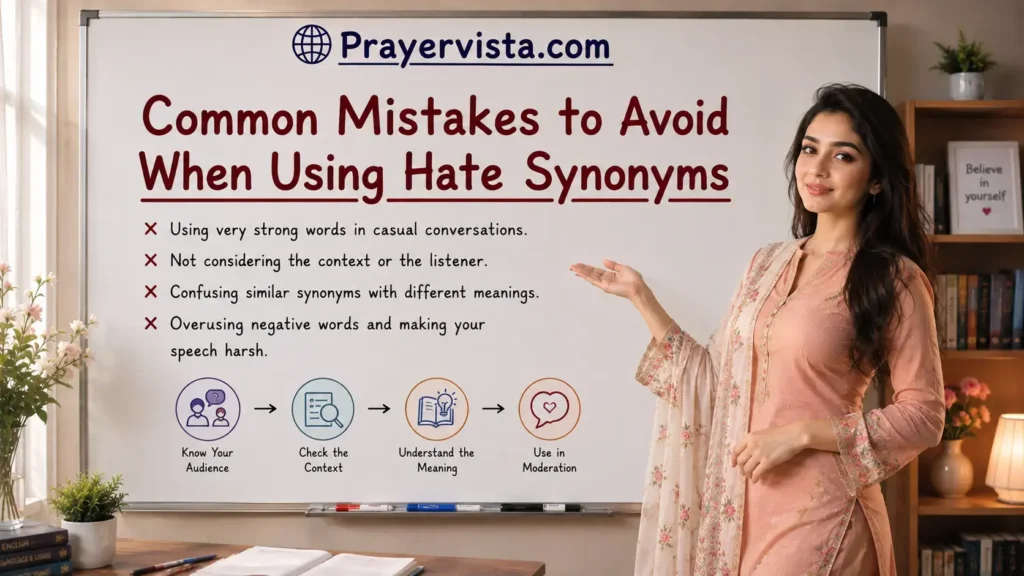
Using synonyms correctly requires more than knowing their meanings. You also need to understand their natural use. A common mistake is replacing small with any word that appears in a synonym list.
For example, miniature does not simply mean every small object. It usually suggests a small representation or model. Petite is normally used for people or clothing sizes. Minor usually refers to importance or seriousness.
Keep these points in mind:
- Do not use tiny for every small amount.
- Use slight for many small changes.
- Use minor for less serious problems.
- Use minimal for very small amounts.
- Use compact for small and practical designs.
- Use miniatures for small models or copies.
- Use meager when the amount is disappointingly low.
- Use petite mainly for people or clothing.
- Check the context before choosing a synonym.
- Avoid difficult words when a simple word is clearer.
Good vocabulary is not about using the hardest word. It is about choosing the most accurate word. A simple synonym can be much better than a complicated one.
Choosing the Right Synonym for Small
Choosing the right synonym depends on what you want to describe. The word small can describe size, amount, number, degree, importance, or effect. Each situation may need a different word.
If you are talking about physical size, tiny, little, compact, and diminutive can work well. For a small amount, words such as minimal, slight, and scant may be better.
For importance, minor and insignificant are useful and for a small change, slight is often natural and for something very small and difficult to see, minuscule or microscopic may be more accurate.
Here are some simple choices:
- Tiny for something very small.
- Compact for something small and practical.
- Slight for a small change.
- Minor for a less serious problem.
- Minimal for a very small amount.
- Minuscule for something extremely small.
- Petite for small and delicately built people or clothing.
- Sparse for something small in number or amount.
Do not choose a synonym only because it looks advanced. Accuracy is more important than difficult vocabulary. A simple word that fits the sentence is usually the best choice.
For example, say “There was a slight delay” instead of using a word that normally describes physical size. Say “The device has a compact design” when you want to show that it is small and easy to fit.
The best synonym makes your meaning clear. It should also sound natural in the sentence.
Brain Test: Synonyms for Small Examples
Exercise 1: Choose the Correct Synonym
Choose the best answer.
- The phone has a ______ design.
a) Compact
b) Huge
c) Massive - There was a ______ difference between the results.
a) Slight
b) Enormous
c) Vast - The scientist observed a ______ particle.
a) Minuscule
b) Large
c) Giant - The student made a ______ mistake.
a) Minor
b) Massive
c) Serious - The machine uses a ______ amount of energy.
a) Minimal
b) Huge
c) Abundant
Answers: 1. Compact, 2. Slight, 3. Minuscule, 4. Minor, 5. Minimal
Exercise 2: Fill in the Blanks
Use the correct synonym for small.
- A ______ bird sat on the branch.
- We noticed a ______ change in the weather.
- The room has ______ space.
- He found a ______ crack in the glass.
- The shop sells ______ models of cars.
Answers:
- Tiny
- Slight
- Limited
- Tiny
- Miniature
Exercise 3: Match the Words
Match each synonym with its correct meaning.
| Synonym | Meaning |
| 1. Compact | A. Very small |
| 2. Minor | B. Small and practical |
| 3. Dainty | C. Less serious |
| 4. Minuscule | D. Small and delicate |
| 5. Minimal | E. Very small amount |
Answers:
- B
- C
- D
- A
- E
Frequently Asked Questions About Synonyms for Small
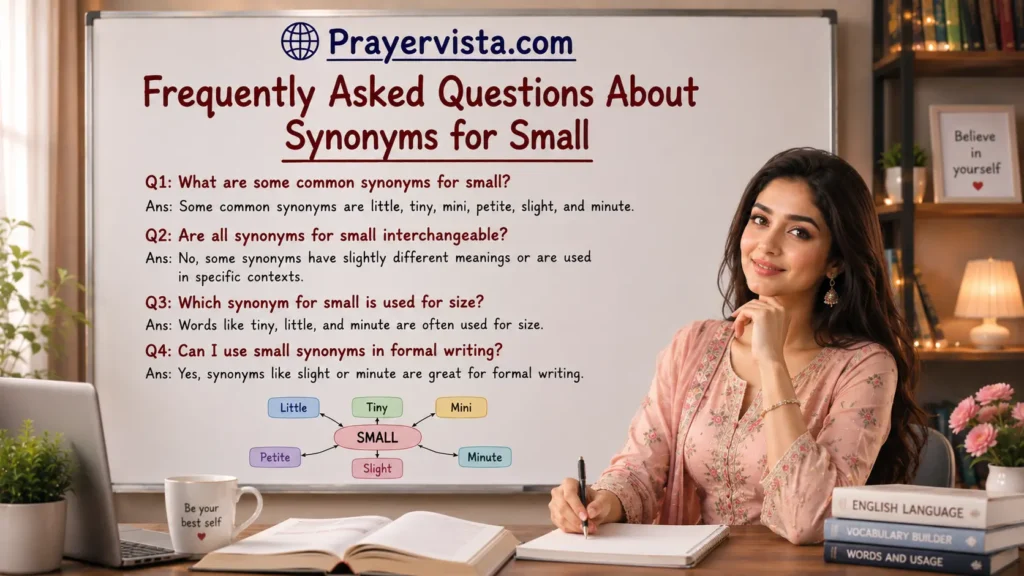
What are 5 synonyms for small?
Five common synonyms for small are little, tiny, compact, petite, and diminutive. Little is common in everyday English, while tiny means very small. Compact suggests something small and practical. Petite often describes a small and delicately built person or clothing size. Diminutive is more formal and means noticeably small.
What are 10 examples of synonyms?
Ten useful synonyms are little, tiny, compact, petite, diminutive, minuscule, slight, minor, minimal, and microscopic. These words are related to smallness, but they are not always interchangeable. Some describe physical size, while others describe amount, degree, or importance. Choosing the right word makes your sentence clearer.
What are some examples of small?
Examples of small things include a button, seed, coin, pebble, shell, key, toy, cup, insect, and notebook. The word small can also describe amounts and numbers. For example, we can say a small amount of water or a small number of students. The exact synonym depends on what you are describing.
What is a synonym for “very small”?
Common synonyms for very small include tiny, minuscule, microscopic, infinitesimal, teeny, and wee. Tiny is natural in everyday English. Minuscule and infinitesimal sound more formal. Teeny and wee are more informal and can sound friendly.
Synonyms for small examples sentences
There are many simple ways to use small synonyms in sentences. For example, “She bought a little bag,” “A tiny bird sat nearby,” “This camera has a compact design,” “There was a slight change,” and “He made a minor mistake.” Each sentence uses a different synonym because the context changes.
Synonyms for small size
Useful synonyms for small size include little, tiny, miniature, compact, petite, and diminutive. Tiny shows that something is very small. Compact suggests that something is small and easy to fit. Miniature usually describes a small model or copy. Petite is often used for people or clothing.
Synonyms for very small amount
Useful synonyms include minimal, slight, scant, meager, modicum, smidgen, and tad. Minimal is common in formal writing. Smidgen and tad are more informal. Meager often suggests that an amount is too small or disappointing. Always choose the word according to the context.
Synonyms for small examples IELTS
For IELTS writing, precise vocabulary is important. Use slight when describing a small change or difference and use minimal for a small amount or level and use few for a small number of countable things. Use negligible when something is so small that its effect is almost unimportant.
Synonyms for small examples in english
Common English synonyms include little, tiny, compact, slight, minor, and minimal. For physical objects, tiny and little are useful. For changes, slight often sounds natural and for problems, minor is a good choice and for amounts, minimal can be more precise.
Very small synonym formal
Formal synonyms for very small include minuscule, infinitesimal, negligible, microscopic, and diminutive. Minuscule describes extremely small size. Infinitesimal can describe an extremely small amount or degree. Negligible suggests that something is too small to have an important effect. These words are useful in formal and academic contexts.
5 synonyms for small
Five useful synonyms are little, tiny, compact, petite, and diminutive. Little is very common in daily English. Tiny gives a stronger sense of small size. Compact suggests something small and practical. Petite often relates to people or clothing, while diminutive is more formal.
another word for small things in life
A natural phrase is “little things in life.” It can describe simple experiences that people appreciate. A quiet morning, a good conversation, or a favorite book can be called one of the little things in life. The phrase often has a warm and positive feeling.
synonyms for small that start with a
There are very few direct synonyms for small that start with the letter A. Abbreviated can mean shortened in length, while attenuated can suggest something reduced or weakened. However, neither word is a general replacement for small. It is better to choose a synonym based on the exact meaning.
synonyms of small is
The phrase “synonyms of small is” is not grammatically correct. A better question is “What are the synonyms of small?” Common synonyms include little, tiny, compact, miniature, petite, slight, minor, minimal, and minuscule. The best choice depends on whether you mean size, amount, degree, number, or importance.
Final Thoughts
Synonyms for small examples help learners understand different ways to describe size, amount, degree, and importance. Words such as little, tiny, compact, slight, minor, minimal, petite, and minuscule have different uses. Simple examples make these differences easier to understand. They also help learners choose the right word in real situations.
Learning synonyms for small sizes can improve everyday English. Words like tiny, miniature, compact, and diminutive can describe physical size. For a very small amount, words such as minimal, slight, scant, and meager can be useful. The context should always guide your choice.
Using synonyms for small examples in English can also improve writing. Students can use precise words instead of repeating small words many times. IELTS learners can use words such as slight, minimal, negligible, and minor when the context is suitable. Formal writing may need more precise vocabulary.
The best very small formal synonym depends on the meaning. Minuscule and infinitesimal can describe extremely small size or degree. Negligible can describe something too small to have an important effect. Informal words such as teeny and wee are better for casual situations.
In the end, learning synonyms for small example sentences is about more than memorizing words. Learn the meaning, context, collocations, and examples of each synonym. Practice them in your own sentences. With regular practice, you can use synonyms for small naturally and make your English clearer, stronger, and more varied.
Discover Related Expert Guides…..
- Synonyms for Good Examples : A Guide to Enriching Vocabulary
- Easy Synonyms for Light Examples in Daily English Writing
- Synonyms for Enemy: 50+ Alternatives to Use in Every Context
- Synonyms for However Quiz: The Complete Guide with Examples

I’m a professional content writer and language researcher at Prayervista.com. I specialize in English synonyms, vocabulary, word meanings, grammar, and educational content. My goal is to create accurate, reader-friendly, and well-researched articles that help learners improve their English with confidence.