Quick Summary
This synonyms for hate list includes 50+ carefully selected alternatives. Each synonym comes with a simple meaning and a real-life example. The guide covers mild, strong, and formal synonyms. It helps you choose the right word for different situations. You will also learn about parts of speech and antonyms. It explains collocations and idioms in simple language. The article highlights common mistakes and how to avoid them. It also includes quizzes to test your knowledge. The FAQs answer the most common questions. Real-life examples make each word easier to understand. Preparing for IELTS? Start here. Want a better vocabulary? This guide will help. Writing in English? This guide is for you. It will improve your English and it will make your writing clearer. It will boost your confidence.
Introduction
A synonyms for hate list is a collection of words that express different levels of dislike, resentment, hostility, contempt, or disgust. The word hate is one of the strongest negative words in English. However, it is not always the best choice. English offers many alternatives. These alternatives help you express your feelings more accurately. They also make your writing sound more natural. Choosing the right synonym improves clarity. It also makes your content more engaging. Most importantly, it reduces repetition.
A synonyms for hate list helps you understand the meaning of each word. It also explains how and when to use it. Some synonyms describe a mild feeling of dislike. Others express intense hostility. Some show moral disapproval or deep contempt. Learning these differences is important. It improves your writing and it strengthens your speaking skills. It also boosts your reading comprehension.
In this guide, you’ll discover 50+ carefully selected synonyms for hate. Each synonym includes a simple meaning. You’ll also find practical examples. Comparison tables make learning easier. Helpful usage tips explain when to use each word. Preparing for IELTS? Writing an essay? Improving your vocabulary? This guide will help you choose the right words with confidence.
By the end of this article, you’ll know which synonym fits different situations. You’ll understand the difference between formal and informal expressions. You’ll also learn how to avoid common vocabulary mistakes. These skills will improve your English. They will also make your writing clearer and more effective. Let’s begin by understanding what the word hate really means.
Table of Contents
- Introduction
- 50+ Synonyms for Hate List
- Category 1: Mild Synonyms for Hate
- Category 2: Strong Synonyms for Hate
- Category 3: Extreme & Formal Synonyms for Hate
- What Is a Better Word for Hate?
- What Is the Strongest Word for Hate?
- Synonyms for Hate List in English
- What Can I Say Instead of “I Hate You”?
- What Are the 4 Types of Hate?
- Parts of Speech and Antonyms of Hate
- Common Collocations with Hate
- Common Mistakes to Avoid When Using Hate Synonyms
- Expert Tips for Using Hate Synonyms
- Idioms and Phrases Related to Hate
- Real-Life Examples of Hate Synonyms in Use
- Test Your Knowledge: Synonyms for Hate Quiz
- Frequently Asked Questions (FAQs)
- Final Thoughts
What Does Hate Mean?

Hate is a verb and noun that describes an extremely strong feeling of dislike, hostility, resentment, or disgust toward someone or something. It is one of the strongest emotion words in English and is often used when someone feels deep anger or complete rejection.
In everyday English, people sometimes use hate casually. For example, saying “I hate rainy days” usually means “I strongly dislike rainy days,” not that you feel genuine hostility. Understanding this difference helps you choose better and more accurate synonyms.
Examples of “Hate”
- I hate waking up early.
- She hates dishonesty.
- They hate bullying.
- His hate for injustice inspired positive change.
Parts of Speech and Antonyms of Hate
| Category | Word | Meaning / Part of Speech | Example |
| Parts of Speech | Hate | Verb | I hate waking up early. |
| Parts of Speech | Hateful | Adjective | His hateful remarks upset everyone. |
| Parts of Speech | Hatred | Noun | Hatred can divide communities. |
| Parts of Speech | Hating | Gerund (Verb Form) | Hating others solves nothing. |
| Parts of Speech | Hated | Past Participle (Adjective) | He was the most hated player on the team. |
What Is a Better Word for Hate?
The best synonym for hate depends on how strongly you feel and the situation in which you’re speaking or writing. Sometimes hate sounds too harsh or emotional. Choosing a more suitable alternative makes your communication sound natural and professional.
Better Words for Hate
| Situation | Better Alternative |
| Mild dislike | Dislike |
| Strong dislike | Detest |
| Deep disgust | Loathe |
| Moral disgust | Abhor |
| Contempt | Despise |
| Bitterness | Resent |
Examples
Instead of:
❌ I hate waiting.
You can say:
- I dislike waiting.
- I can’t stand waiting.
- I detest waiting.
Instead of:
❌ People hate corruption.
You can say:
- People despise corruption.
- People condemn corruption.
- People abhor corruption.
Using different synonyms helps avoid repetition and makes your writing richer and more expressive.
What Is the Strongest Word for Hate?

Some English words express even stronger emotions than hate. These synonyms are often used when describing deep disgust, intense hostility, moral outrage, or complete rejection. Many of them appear in literature, speeches, academic writing, and formal discussions.
Among the strongest alternatives are abhor, loathe, despise, abominate, and execrate. Although they all express extreme dislike, each word has a slightly different meaning and is used in different contexts.
Strongest Synonyms for Hate
| Word | Strength | Best Context |
| Loathe | ⭐⭐⭐⭐⭐ | Personal hatred |
| Abhor | ⭐⭐⭐⭐⭐ | Moral disgust |
| Despise | ⭐⭐⭐⭐⭐ | Contempt |
| Abominate | ⭐⭐⭐⭐⭐ | Formal writing |
| Execrate | ⭐⭐⭐⭐⭐ | Literary writing |
| Detest | ⭐⭐⭐⭐ | Everyday English |
| Revile | ⭐⭐⭐⭐ | Public criticism |
| Scorn | ⭐⭐⭐⭐ | Literature |
| Disdain | ⭐⭐⭐⭐ | Formal speech |
| Condemn | ⭐⭐⭐⭐ | News and official statements |
Which One Should You Use?
- Dislike → Everyday situations
- Detest → Strong personal dislike
- Loathe → Intense emotional hatred
- Abhor → Moral disgust
- Despise → Lack of respect
- Condemn → Formal criticism
- Oppose → Professional disagreement
These alternatives allow you to express emotions more accurately without overusing the word hate.
Top 50+ Synonyms for Hate List
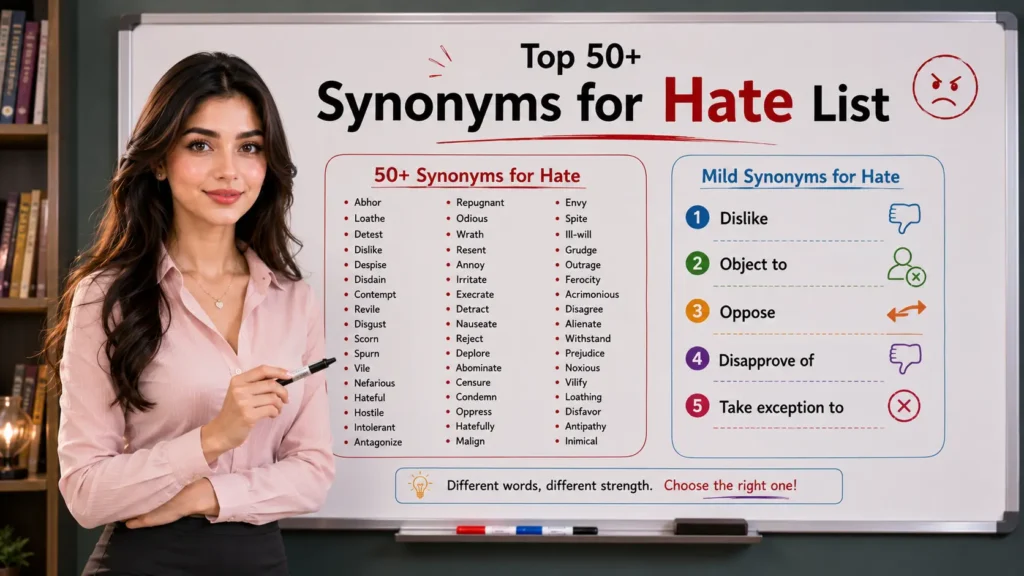
The English language offers many alternatives to the word hate. Some express mild dislike, while others describe deep resentment, contempt, or extreme hostility. Choosing the right synonym helps you communicate more accurately and naturally. Below is a carefully organized synonyms for hate list divided into three categories based on the intensity of emotion.
Mild Synonyms for Hate
These mild synonyms for hate express dislike, disagreement, or slight annoyance rather than deep hatred. They are commonly used in everyday conversations, academic writing, and professional communication.
1. Dislike
Meaning: To not enjoy or approve of someone or something.
Example: I dislike waking up early on weekends.
2. Object to
Meaning: To express disagreement or opposition.
Example: Many residents object to the new traffic rules.
3. Oppose
Meaning: To disagree with or fight against something.
Example: Several teachers oppose the new policy.
4. Disapprove of
Meaning: To think something is wrong or unacceptable.
Example: My parents disapprove of smoking.
5. Resent
Meaning: To feel bitterness because of unfair treatment.
Example: She resents being ignored during meetings.
6. Reject
Meaning: To refuse to accept or support something.
Example: The committee rejected the proposal.
7. Avoid
Meaning: To stay away from someone or something.
Example: I avoid negative people whenever possible.
8. Shun
Meaning: To deliberately keep away from someone or something.
Example: Honest people often shun dishonest behavior.
9. Resist
Meaning: To refuse to accept or give in to something.
Example: They resisted the sudden changes.
10. Question
Meaning: To express doubt or uncertainty.
Example: Many experts questioned the decision.
11. Doubt
Meaning: To feel uncertain about something.
Example: I doubt his explanation.
12. Mind
Meaning: To be bothered or annoyed by something.
Example: I don’t mind waiting for a few minutes.
13. Protest
Meaning: To publicly show disagreement.
Example: Workers protested against unfair wages.
14. Frown upon
Meaning: To disapprove of something.
Example: Most schools frown upon cheating.
15. Have reservations about
Meaning: To feel uncertain or doubtful.
Example: She has reservations about investing her money.
16. Prefer not to
Meaning: To politely refuse something.
Example: I’d prefer not to discuss politics.
17. Have no interest in
Meaning: To not like or enjoy something.
Example: He has no interest in gossip.
Comparison Table: Mild Synonyms for Hate
| Synonym | Meaning | Strength | Best Used For | Example |
| Dislike | Not enjoy something | ⭐ | Everyday conversations | I dislike loud music. |
| Object to | Express disagreement | ⭐⭐ | Formal and professional writing | We object to the proposal. |
| Oppose | Disagree or resist | ⭐⭐ | Debates and discussions | They oppose the new law. |
| Resent | Feel bitterness | ⭐⭐⭐ | Personal emotions | She resents unfair treatment. |
| Frown upon | Disapprove of | ⭐⭐ | Advice and opinions | Teachers frown upon cheating. |
This comparison table helps readers quickly understand the meaning, strength, and best usage of the most common mild synonyms for hate.
Strong Synonyms for Hate
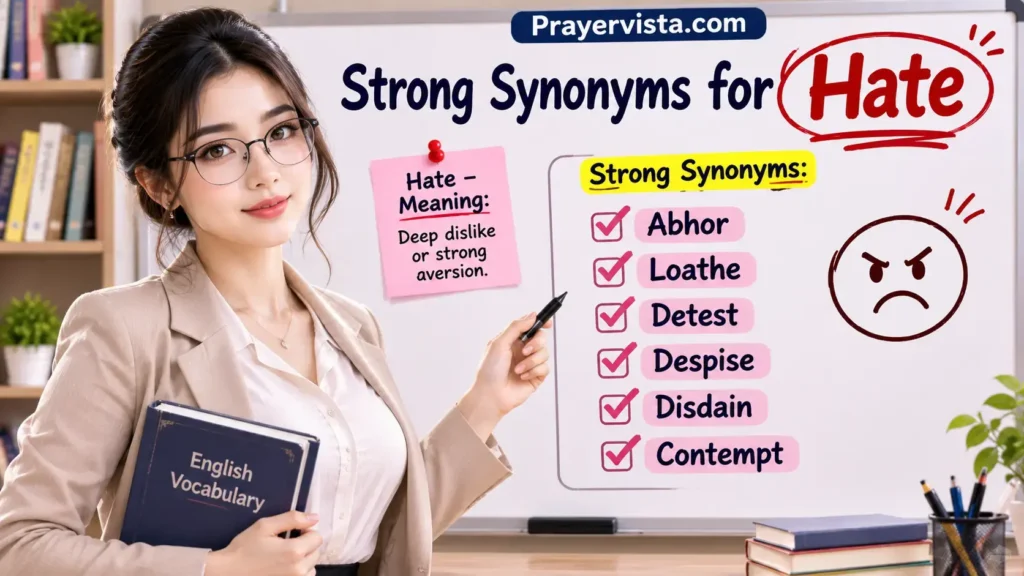
These strong synonyms for hate express intense dislike, contempt, anger, or disgust. They are more powerful than words like dislike or oppose and are commonly used in literature, formal writing, speeches, and everyday English when strong emotions need to be expressed.
18. Detest
Meaning: To strongly dislike someone or something.
Example: I detest dishonesty because it destroys trust.
19. Loathe
Meaning: To feel extreme dislike or hatred.
Example: She loathes cruelty to animals.
20. Despise
Meaning: To dislike someone because you have no respect for them.
Example: Many people despise corruption.
21. Abhor
Meaning: To regard something with deep hatred or disgust.
Example: We all abhor violence and injustice.
22. Disdain
Meaning: To consider someone or something unworthy of respect.
Example: He looked at the dishonest businessman with disdain.
23. Scorn
Meaning: To treat someone with contempt or disrespect.
Example: They scorned his dishonest behavior.
24. Condemn
Meaning: To strongly express disapproval of something.
Example: World leaders condemned the terrorist attack.
25. Deplore
Meaning: To strongly disapprove of or regret something.
Example: Experts deplore environmental pollution.
26. Revile
Meaning: To criticize someone in a harsh or abusive way.
Example: Critics revealed the company’s decision.
27. Vilify
Meaning: To speak or write about someone unfairly to damage their reputation.
Example: The politician was unfairly vilified by the media.
28. Malign
Meaning: To make false statements that damage someone’s reputation.
Example: They tried to malign their competitors.
29. Ridicule
Meaning: To make fun of someone in an insulting way.
Example: Never ridicule people for their mistakes.
30. Mock
Meaning: To laugh at or imitate someone in a disrespectful way.
Example: Some students mocked his accent.
31. Taunt
Meaning: To repeatedly tease or insult someone.
Example: The crowd taunted the opposing team.
32. Insult
Meaning: To offend someone with rude or disrespectful words.
Example: It’s never right to insult others.
33. Offend
Meaning: To hurt someone’s feelings by saying or doing something rude.
Example: His comments offended many people.
34. Spurn
Meaning: To reject someone or something with contempt.
Example: She spurned every offer of assistance.
Comparison Table: Strong Synonyms for Hate
| Synonym | Meaning | Strength | Best Used For | Example |
| Detest | Strongly dislike | ⭐⭐⭐⭐ | Everyday English | I detest dishonesty. |
| Loathe | Feel intense hatred | ⭐⭐⭐⭐⭐ | Strong emotions | She loathes cruelty. |
| Despise | Hate without respect | ⭐⭐⭐⭐⭐ | Moral judgment | People despise corruption. |
| Condemn | Publicly criticize | ⭐⭐⭐⭐ | News, speeches, and formal writing | Leaders condemned the attack. |
This group contains strong alternatives to “hate” that express powerful negative emotions. Use them carefully because they carry much greater emotional weight than everyday words like dislike or object to.
Extreme & Formal Synonyms for Hate
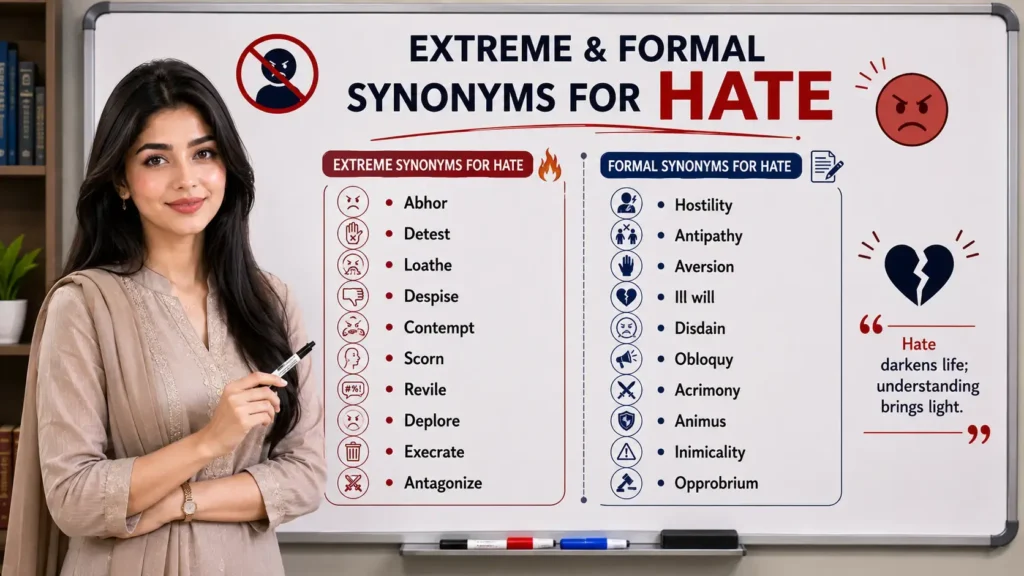
These extreme and formal synonyms for hate express the highest level of hatred, disgust, rejection, or condemnation. They are commonly used in academic writing, literature, legal documents, journalism, historical texts, and formal speeches. Because these words are very strong, they should be used only when the situation truly requires such intensity.
35. Abominate
Meaning: To hate or dislike someone or something intensely.
Example: She abominates cruelty to innocent animals.
36. Execrate
Meaning: To hate or condemn someone or something with great intensity.
Example: The poet executed war and violence.
37. Contemn
Meaning: To treat someone or something with complete contempt.
Example: He condemned dishonesty and corruption.
38. Repudiate
Meaning: To reject or refuse to accept something completely.
Example: The company repudiated the false allegations.
39. Denounce
Meaning: To publicly condemn or criticize someone or something.
Example: Human rights organizations denounced the attacks.
40. Defame
Meaning: To damage someone’s reputation through false statements.
Example: The newspaper was accused of trying to defame the businessman.
41. Slander
Meaning: To make false spoken statements that harm someone’s reputation.
Example: She sued her former colleague for slander.
42. Disgust
Meaning: To cause a strong feeling of revulsion or dislike.
Example: Acts of cruelty disgust many people.
43. Repel
Meaning: To cause someone to feel strong dislike or disgust.
Example: The unpleasant smell repelled everyone in the room.
44. Revolt
Meaning: To fill someone with horror or disgust.
Example: The shocking crime revolted the entire community.
45. Nauseate
Meaning: To make someone feel sick or disgusted.
Example: The foul odor nauseated the visitors.
46. Renounce
Meaning: To formally give up or reject a belief, habit, or action.
Example: He renounced violence and chose a peaceful life.
47. Turn Against
Meaning: To become hostile or unfriendly toward someone.
Example: Several supporters turned against the leader after the scandal.
48. Boycott
Meaning: To refuse to support or buy from someone or something.
Example: Customers boycotted the company after the controversy.
49. Can’t Stand
Meaning: To strongly dislike someone or something.
Example: I can’t stand people who constantly lie.
50. Have No Use For
Meaning: To completely dislike or reject something.
Example: She has no use for dishonest behavior.
Comparison Table: Extreme & Formal Synonyms for Hate
| Synonym | Meaning | Strength | Best Used For | Example |
| Abominate | Hate intensely | ⭐⭐⭐⭐⭐ | Literature & formal writing | He abominates injustice. |
| Execrate | Condemn with extreme hatred | ⭐⭐⭐⭐⭐ | Historical and literary texts | The writer executed tyranny. |
| Repudiate | Reject completely | ⭐⭐⭐⭐ | Legal, academic, and business writing | The company repudiated the accusation. |
| Denounce | Publicly condemn | ⭐⭐⭐⭐ | News reports and official statements | Leaders denounced corruption. |
What Is the Strongest Word for Hate?
The strongest word for hate depends on the context and the emotion you want to express. While hate already describes a powerful feeling of dislike, some English words convey even deeper emotions such as contempt, disgust, hostility, or complete rejection.
The table below highlights some of the strongest alternatives and explains when to use them.
| Word | Meaning | Best Used For | Example Sentence |
| Abominate | To hate something completely | Formal writing | She abominates cruelty in every form. |
| Execrate | To curse or condemn with intense hatred | Literature and historical writing | The poet executed war and oppression. |
| Contemn | To despise someone completely | Academic and literary English | He condemned dishonest behavior. |
| Vilipend | To treat someone or something with great contempt | Formal speeches | The article exposed corruption in society. |
Which Strong Word Should You Choose?
The right synonym depends on your purpose.
- Use abominate when describing complete hatred or disgust.
- Choose to excel in literary or historical writing.
- Use contempt when expressing deep contempt.
- Select vilipend for formal criticism or speeches.
- Use anathematize in religious or historical discussions.
- Choose deride or belittle when referring to mocking or insulting behavior.
- Use snub when someone intentionally ignores or rejects another person.
Synonyms for Hate List in English
The English language contains many words that can replace hate, but not all of them have the same meaning or intensity. Some express mild dislike, while others describe hostility, contempt, rejection, or emotional pain. Choosing the right word depends on the situation, the relationship between the people involved, and the message you want to communicate.
| Word | Meaning | Best Context | Example Sentence |
|---|---|---|---|
| Be repulsed by | To feel strong disgust | Everyday & formal | I was repulsed by the terrible smell. |
| Be sickened by | To feel emotionally or physically disgusted | News & conversation | Many people were sickened by the violent incident. |
When Should You Use These Synonyms?
Different situations require different words. Choosing the most suitable synonym improves both your writing and speaking.
| Situation | Recommended Word |
| Casual conversation | Take offense at |
| Formal writing | Hold in contempt |
| Academic English | Harbor hostility |
| Emotional writing | Bear ill will toward |
| Professional communication | Disfavor |
| Describing disgust | Be repulsed by |
| Showing bitterness | Harbor resentment |
Common Mistakes to Avoid
Using a synonym simply because it appears in a list can make your writing sound unnatural. Keep these points in mind:
❌ I disfavor broccoli. (Too formal for everyday conversation.)
✅ I dislike broccoli.
❌ She anathematized her homework. (Incorrect context.)
✅ She couldn’t stand doing her homework.
❌ He held his friend in contempt because he arrived late once. (Too strong for a minor issue.)
✅ He was annoyed because his friend arrived late.
What Can I Say Instead of “I Hate You”?
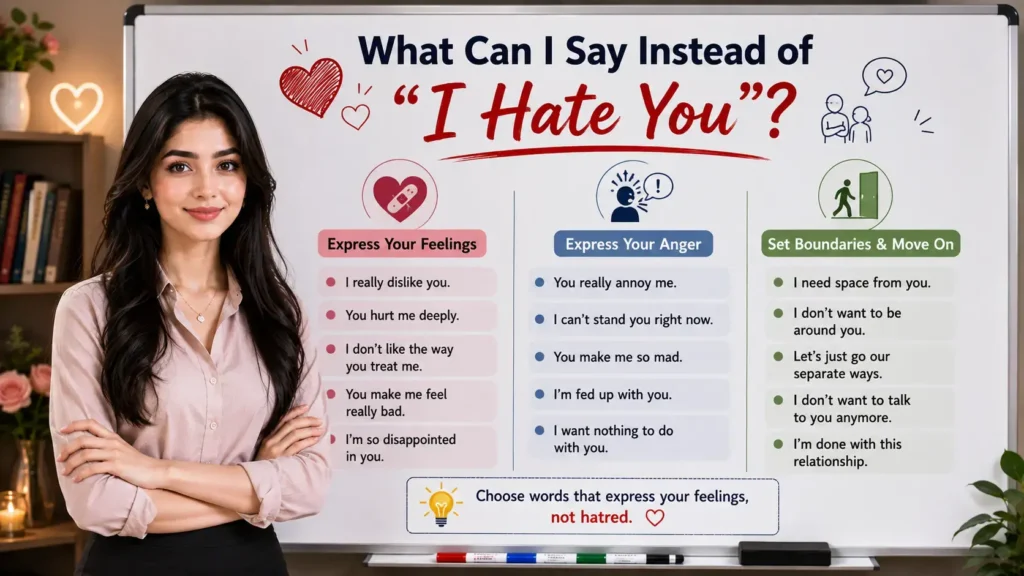
Saying “I hate you” can sound extremely harsh and may damage relationships. In many situations, it’s better to express your feelings in a calmer and more respectful way. Choosing different words allows you to communicate disappointment, frustration, or anger without sounding overly aggressive.
The alternatives below express different levels of emotion. Some are suitable for everyday conversations, while others are better for formal or emotional discussions.
| Alternative Expression | Meaning | Best Used For | Example |
| I’m really upset with you. | Expresses disappointment without hatred. | Everyday conversation | I’m really upset with you for breaking your promise. |
| I’m angry with you. | Shows anger directly. | Casual conversations | I’m angry with you because you lied. |
| I’m disappointed in you. | Shows sadness rather than hatred. | Friends and family | I’m disappointed in you after what happened. |
| You’ve hurt my feelings. | Explains emotional pain. | Personal relationships | You’ve hurt my feelings by ignoring me. |
Which Alternative Should You Use?
The best replacement depends on how you feel and what you want to communicate.
| Emotion | Better Expression |
| Angry | I’m angry with you. |
| Sad | I’m disappointed in you. |
| Hurt | You’ve hurt my feelings. |
| Frustrated | I’m frustrated with your behavior. |
Why Avoid Saying “I Hate You”?
Although people sometimes say “I hate you” in moments of anger, those words can leave lasting emotional wounds. Expressing your feelings more clearly helps others understand the problem and creates a better chance of resolving conflicts.
Instead of attacking the person, focus on their actions and explain how those actions affected you. This approach encourages healthier communication and reduces unnecessary arguments.
Better Communication Tips
- Speak calmly, even when you’re upset.
- Describe the behavior instead of attacking the person.
- Use “I feel…” statements to explain your emotions.
- Listen to the other person’s perspective before responding.
- Give yourself time to cool down if emotions are overwhelming.
What Are the 4 Types of Hate?
Although hate is a single emotion, psychologists, educators, and communication experts often describe it in different forms based on its cause and expression. Understanding these types can help you recognize emotions more clearly and communicate them more effectively.
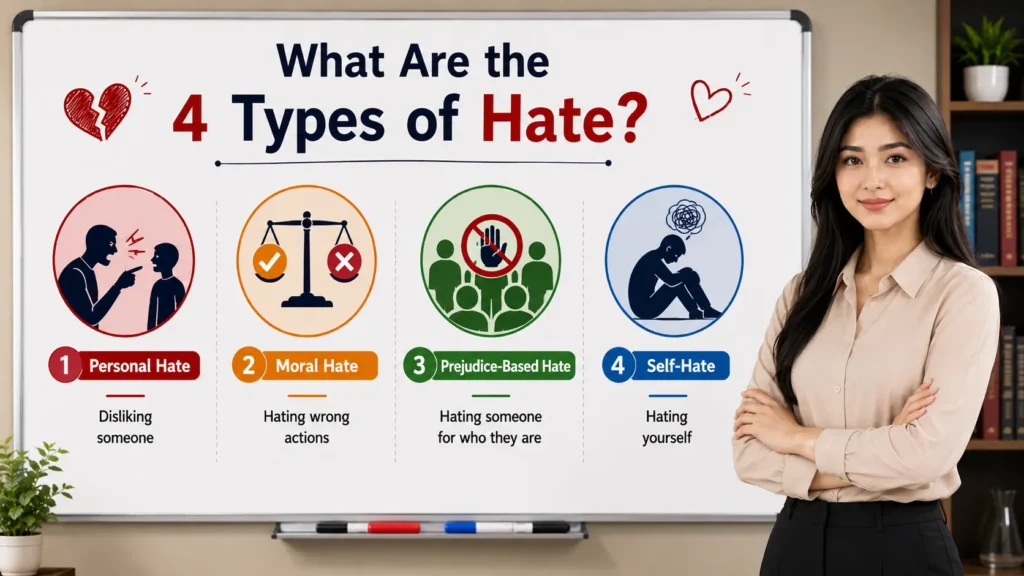
1. Personal Hate
Personal hate develops because of direct experiences with another person. It may result from betrayal, repeated arguments, dishonesty, or broken trust.
Characteristics:
- Often directed at one specific person.
- Usually develops over time.
- Can affect friendships, families, or workplaces.
Example:
After years of dishonesty, he developed a strong dislike for his former business partner.
2. Moral Hate
Moral hate is directed toward actions or behaviors that someone believes are wrong or unethical. People often feel this type of emotion toward crimes, violence, abuse, or corruption rather than toward individuals themselves.
Characteristics:
- Based on personal values.
- Focuses on actions instead of personalities.
- Common in news reports and public discussions.
Example:
Many citizens strongly reject corruption because they believe it harms society.
3. Prejudice-Based Hate
This form of hate comes from bias or prejudice against individuals or groups because of characteristics such as race, religion, nationality, gender, or other identities. It is harmful because it judges people based on stereotypes instead of individual actions.
Characteristics:
- Based on prejudice rather than personal experience.
- Can lead to discrimination or unfair treatment.
- Often addressed through education and equal rights initiatives.
Example:
Communities work together to reduce prejudice and encourage mutual respect.
4. Self-Hate
Self-hate refers to intense negative feelings toward oneself. It often involves harsh self-criticism, shame, or feelings of worthlessness. Rather than being a healthy response, it is generally viewed as a sign that someone may need support, self-compassion, or professional help.
Characteristics:
- Directed inward instead of toward others.
- May involve persistent self-criticism.
- Can affect confidence, relationships, and well-being.
Example:
Learning self-acceptance can help people replace harsh self-criticism with healthier thinking.
Comparison Table: The Four Types of Hate
| Type | Main Focus | Common Cause | Example |
| Personal Hate | A specific person | Betrayal or conflict | Losing trust after repeated lies. |
| Moral Hate | Wrong actions | Ethical beliefs | Rejecting corruption or violence. |
| Prejudice-Based Hate | A group of people | Bias or stereotypes | Treating people unfairly because of prejudice. |
| Self-Hate | Yourself | Harsh self-criticism | Constantly focusing only on personal flaws. |
Hate Antonyms
Antonyms of hate are words that express love, affection, admiration, respect, acceptance, or positive feelings toward someone or something. Learning antonyms helps you build a stronger vocabulary and understand the opposite meanings of negative emotions.
Whether you’re writing an essay, preparing for an exam, or improving your English, knowing the opposite of hate makes your communication more balanced and expressive.
Common Antonyms of Hate
| Antonym | Meaning | Example Sentence |
| Love | To feel deep affection for someone or something. | I love spending time with my family. |
| Like | To find someone or something pleasant. | She likes reading mystery novels. |
| Adore | To love someone or something very much. | The children adore their grandmother. |
| Cherish | To value something deeply. | He cherishes every memory with his parents. |
Comparison Table: Hate vs. Its Antonyms
| Negative Word | Positive Opposite | Difference |
| Hate | Love | Strong dislike vs. deep affection |
| Despise | Admire | Contempt vs. respect |
| Reject | Accept | Refuse vs. receive willingly |
| Condemn | Praise | Criticize vs. appreciate |
When Should You Use These Antonyms?
Choose the antonym based on your message.
- Use love when expressing deep affection.
- Use like for casual positive feelings.
- Use admiration when respecting someone’s abilities.
- Use cherish for precious memories or relationships.
- Use respect in professional or educational settings.
- Use appreciation to thank someone.
- Use accept when receiving ideas or apologies.
- Use support when encouraging someone.
Common Mistakes to Avoid
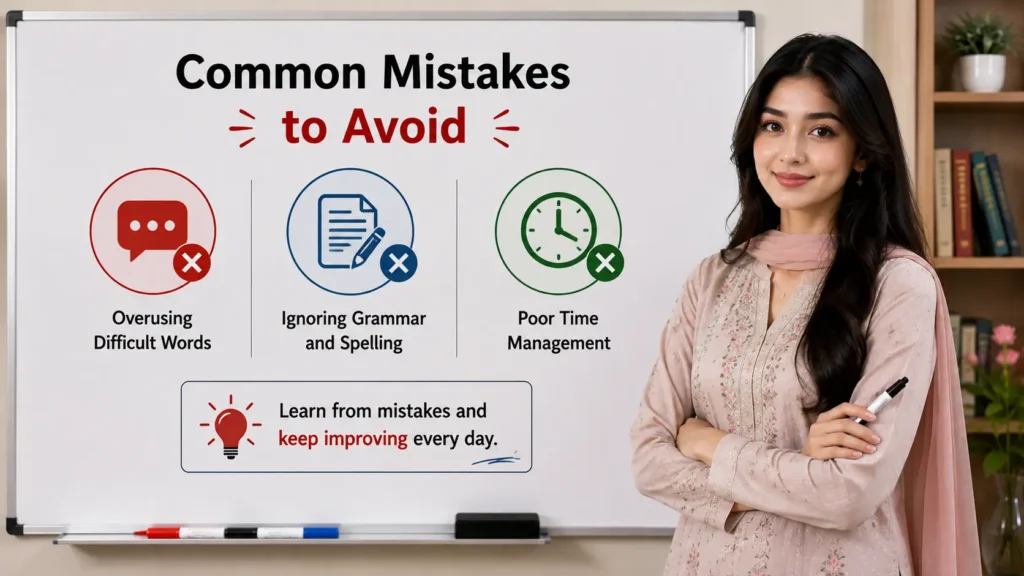
❌ I admire chocolate.
✅ I like chocolate.
❌ I cherish my favorite TV show.
✅ I enjoy my favorite TV show.
❌ I honor pizza.
✅ I love pizza.
Choose antonyms that fit the strength of your emotion and the context. Using the right word makes your English sound more natural and accurate.
Common Collocations with Hate
Collocations are words that naturally go together. Learning common hate collocations helps you speak and write English more fluently.
| Collocation | Meaning | Example Sentence |
| Hate crime | A crime motivated by prejudice. | The police investigated the hate crime. |
| Hate speech | Speech that attacks or insults a group. | Many countries have laws against hate speech. |
| Hate doing something | I strongly dislike an activity. | I hate doing the dishes. |
| Hate someone | Feel strong dislike toward a person. | She doesn’t hate anyone. |
| Hate violence | Strongly oppose violence. | Most people hate violence. |
These collocations are frequently used in books, newspapers, academic writing, and everyday English, making them valuable additions to your vocabulary.
FAQs
What are 10 bad synonyms?
The word bad has many synonyms that describe poor quality, unpleasant situations, or negative experiences. Some of the most common synonyms are awful, terrible, horrible, dreadful, poor, inferior, faulty, unsatisfactory, lousy, and rotten. Using these alternatives instead of repeating bad makes your writing more varied, descriptive, and engaging.
What is another word for hate speech?
There are several alternatives to hate speech, depending on the context. Common expressions include offensive speech, abusive language, discriminatory language, inflammatory language, hostile remarks, and bigoted remarks. While these phrases have similar meanings, hate speech is often a specific legal or social term, so choose the alternative that best fits your context.
Is this synonym for hate list helpful for IELTS students?
Yes. This synonym for hate list is highly useful for IELTS Speaking and Writing because it helps you replace repetitive words with more precise vocabulary. Using appropriate synonyms naturally improves your Lexical Resource, one of the key scoring criteria in the IELTS exam. Just remember to use each synonym in the correct context rather than memorizing long lists.
What is a synonym for hate list in English?
A synonym for hate list in English is a collection of words and phrases that express different levels of dislike, hostility, resentment, or contempt. These alternatives help English learners, writers, and students choose the most suitable word for different situations. Learning them improves vocabulary, reduces repetition, and makes both writing and speaking more effective.
Can hate and dislike be used interchangeably?
Not always. Although both words express negative feelings, dislike refers to a mild feeling of not enjoying something, while hate describes a much stronger emotional reaction. Using the correct word makes your communication clearer and more accurate, especially in formal writing or academic English.
Why should I learn synonyms instead of repeating “hate”?
Learning synonyms helps you express ideas more accurately and naturally. It also improves your vocabulary, writing style, and speaking skills by reducing repetition. Whether you’re preparing for exams, writing articles, or having everyday conversations, using a variety of words makes your English sound more fluent, professional, and engaging.
When should I use “hate” instead of a synonym?
Use hate when you want to show a very strong feeling. For weaker emotions, choose a milder synonym. This makes your writing more natural. It also helps readers understand your exact meaning.
What is the difference between hate, contempt, and disgust?
These words have different meanings. Hate means strong dislike. Contempt means having no respect for someone. Disgust means feeling sick or deeply offended by something.
Are hate synonyms used in formal writing?
Yes. Many hate synonyms are suitable for formal writing. Words like oppose, disapprove, and denounce sound more professional. Always choose the word that fits the context.
How can I remember hate synonyms more easily?
Learn synonyms in small groups. Practice them in simple sentences. Read English every day and review the words often. Regular practice improves your vocabulary.
What are the most commonly used synonyms for hate?
Some common synonyms are dislike, detest, loathe, despise, resent, oppose, reject, and abhor. These words are widely used in speaking and writing. Learning them will make your English more natural and expressive.
Test Your Knowledge: Synonyms for Hate Quiz
Check how much you’ve learned from this guide. Complete the three quizzes below and compare your answers at the end.
Quiz 1: Choose the Correct Synonym
Select the best synonym for each sentence.
1. I ______ waiting in long traffic jams.
a) Love
b) Detest
c) Enjoy
Answer: b) Detest
2. Many people ______ corruption because it is dishonest.
a) Admire
b) Abhor
c) Welcome
Answer: b) Abhor
3. She ______ the new policy and voted against it.
a) Opposed
b) Accepted
c) Supported
Answer: a) Opposed
4. He ______ rude behavior and avoids it whenever possible.
a) Appreciates
b) Loathes
c) Encourages
Answer: b) Loathes
5. The committee ______ the proposal after careful discussion.
a) Rejected
b) Approved
c) Praised
Answer: a) Rejected
Quiz 2: Fill in the Blanks
Choose the correct word from the box.
Word Bank: despise, dislike, condemn, resent, reject
1. I ______ waking up early on Sundays.
Answer: dislike
2. Many citizens ______ corruption.
Answer: condemn
3. She ______ unfair treatment at work.
Answer: resents
4. They decided to ______ the offer.
Answer: reject
5. Honest people ______ cheating.
Answer: despise
Quiz 3: Match the Word with Its Meaning
Match each word with the correct meaning.
Words
- Loathe
- Reject
- Resent
- Oppose
- Abhor
Meanings
A. Refuse to accept
B. Strongly dislike
C. Feel bitterness
D. Disagree with
E. Hate because it is morally wrong
Answers
1 → B – Strongly dislike
2 → A – Refuse to accept
3 → C – Feel bitterness
4 → D – Disagree with
5 → E – Hate because it is morally wrong
Common Mistakes to Avoid When Using Hate Synonyms
Using the wrong synonym can change the meaning of your sentence. Here are some common mistakes and the correct way to use these words.
1. Using a Strong Synonym for a Small Dislike
❌ I abhor washing dishes.
✅ I dislike washing dishes.
Why? Abhor is too strong for an everyday activity.
2. Confusing “Despise” with “Dislike”
❌ I despise chocolate.
✅ I dislike chocolate.
Why? Despise expresses deep contempt, not a simple preference.
3. Using Formal Words in Casual Conversations
❌ I execrate rainy days.
✅ I hate rainy days.
Why? Execrate is mainly used in literature and formal writing.
4. Choosing the Wrong Context
❌ The teacher loathes homework.
✅ The teacher dislikes homework.
Why? Loathe is much stronger than the situation requires.
5. Repeating the Same Word
❌ I hate waiting. I hate traffic. I hate noise.
✅ I dislike waiting, detest traffic, and can’t stand loud noise.
Why? Using different synonyms improves readability and vocabulary.
Idioms and Phrases Related to Hate
Idioms and phrases help you express strong emotions in a more natural way. Although they don’t always mean hate directly, they are commonly used to describe dislike, anger, resentment, or hostility.
1. Bad Blood
Meaning: Feelings of anger or hostility between people.
Example: There has been bad blood between the two families for years.
2. Rub Someone the Wrong Way
Meaning: To annoy or irritate someone.
Example: His rude attitude rubs me the wrong way.
3. Get on Someone’s Nerves
Meaning: To annoy someone repeatedly.
Example: Loud noises get on my nerves.
4. Hold a Grudge
Meaning: To stay angry with someone for a long time.
Example: She still holds a grudge against her former friend.
5. Bear a Grudge
Meaning: To keep feelings of resentment.
Example: It’s unhealthy to bear a grudge for years.
6. At Each Other’s Throats
Meaning: Constantly arguing or fighting.
Example: The two neighbors are always at each other’s throats.
7. Give Someone the Cold Shoulder
Meaning: To ignore someone on purpose.
Example: He gave me the cold shoulder after the argument.
8. Have It in for Someone
Meaning: To dislike someone and want them to fail.
Example: It feels like the manager has it in for him.
9. Turn Up Your Nose At
Meaning: To reject something because you think it is not good enough.
Example: Don’t turn up your nose at honest work.
10. Leave a Bad Taste in Someone’s Mouth
Meaning: To create an unpleasant feeling after an experience.
Example: The poor customer service left a bad taste in my mouth.
Why Learn These Idioms?
Learning idioms makes your English sound more natural and fluent. They are commonly used in conversations, books, movies, and English proficiency exams. Using them correctly also improves your vocabulary and helps you express emotions more effectively.
Real-Life Examples of Hate Synonyms in Use
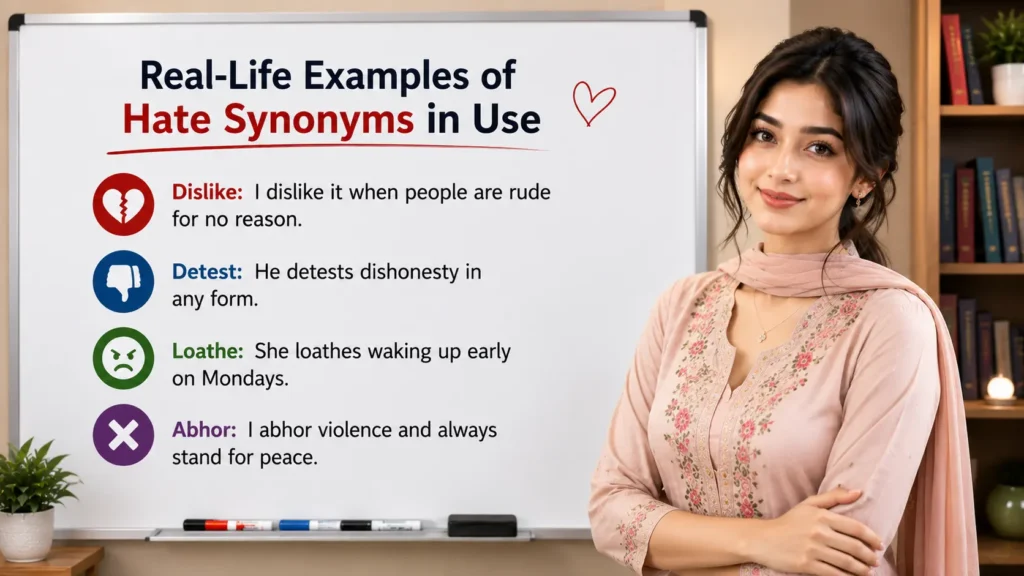
Understanding synonyms is easier when you see them in real-life situations. The examples below show how different hate synonyms are naturally used in everyday conversations, workplaces, schools, and professional settings.
Everyday Conversation
- I dislike getting stuck in traffic every morning.
- She can’t stand loud music while studying.
- We resent being treated unfairly.
- He objects to unnecessary spending.
- They oppose raising prices again.
School and Education
- The teacher disapproved of cheating during the exam.
- Many students detest homework during holidays.
- Parents frown upon bullying at school.
- Our principal condemned vandalism on campus.
- Everyone abhors discrimination in the classroom.
Workplace
- Employees rejected the new policy.
- The manager criticized poor customer service.
- Staff members protested the unfair decision.
- Several workers resisted the sudden changes.
- Customers boycotted the brand after the controversy.
News and Media
- World leaders denounced the violent attack.
- Citizens despise corruption in public offices.
- Human rights groups condemned the abuse.
- Journalists questioned the government’s decision.
- The public revealed the dishonest official.
Personal Relationships
- She forgave her friend instead of holding a grudge.
- He looked down on people who lied.
- They turned against each other after the disagreement.
- I take offense at disrespectful comments.
- Good communication helps prevent hatred from growing.
Why Do Real-Life Examples Matter?
Real-life examples show how each synonym fits different situations. Instead of memorizing long word lists, you learn how native speakers naturally use these words. This makes it easier to improve your vocabulary, write better sentences, and communicate with confidence in everyday English.
Final Thoughts
Learning synonyms for hate list is one of the best ways to expand your English vocabulary and express negative emotions more accurately. Instead of repeating the word hate, you can choose from many alternatives that match different situations, levels of emotion, and writing styles. Using the right synonym makes your communication clearer, more natural, and more effective.
In this comprehensive synonyms for hate list, you explored 50+ carefully selected synonyms with their meanings, example sentences, comparison tables, common collocations, idioms, antonyms, real-life examples, quizzes, and practical usage tips. You also learned how to choose the most suitable synonym for everyday conversations, academic writing, professional communication, and English proficiency exams such as IELTS.
Keep these synonyms for hate list as a handy reference whenever you write or speak English. Practice these words regularly by using them in your own sentences and conversations. The more you use them correctly, the richer your vocabulary will become, helping you write with greater confidence, avoid repetition, and communicate your ideas more precisely.
Explore More In-Depth Articles…..
- Synonyms for Good Examples : A Guide to Enriching Vocabulary
- Easy Synonyms for Light Examples in Daily English Writing
- Synonyms for Enemy: 50+ Alternatives to Use in Every Context
- Synonyms for However Quiz: The Complete Guide with Examples

Hi, I’m Sophia Reynolds, a content writer at Prayervista.com. I love writing clear and engaging content about synonyms and vocabulary. My goal is to help readers understand word meanings, improve their English, and choose the right words with confidence through simple and accurate explanations.