Quick Summary
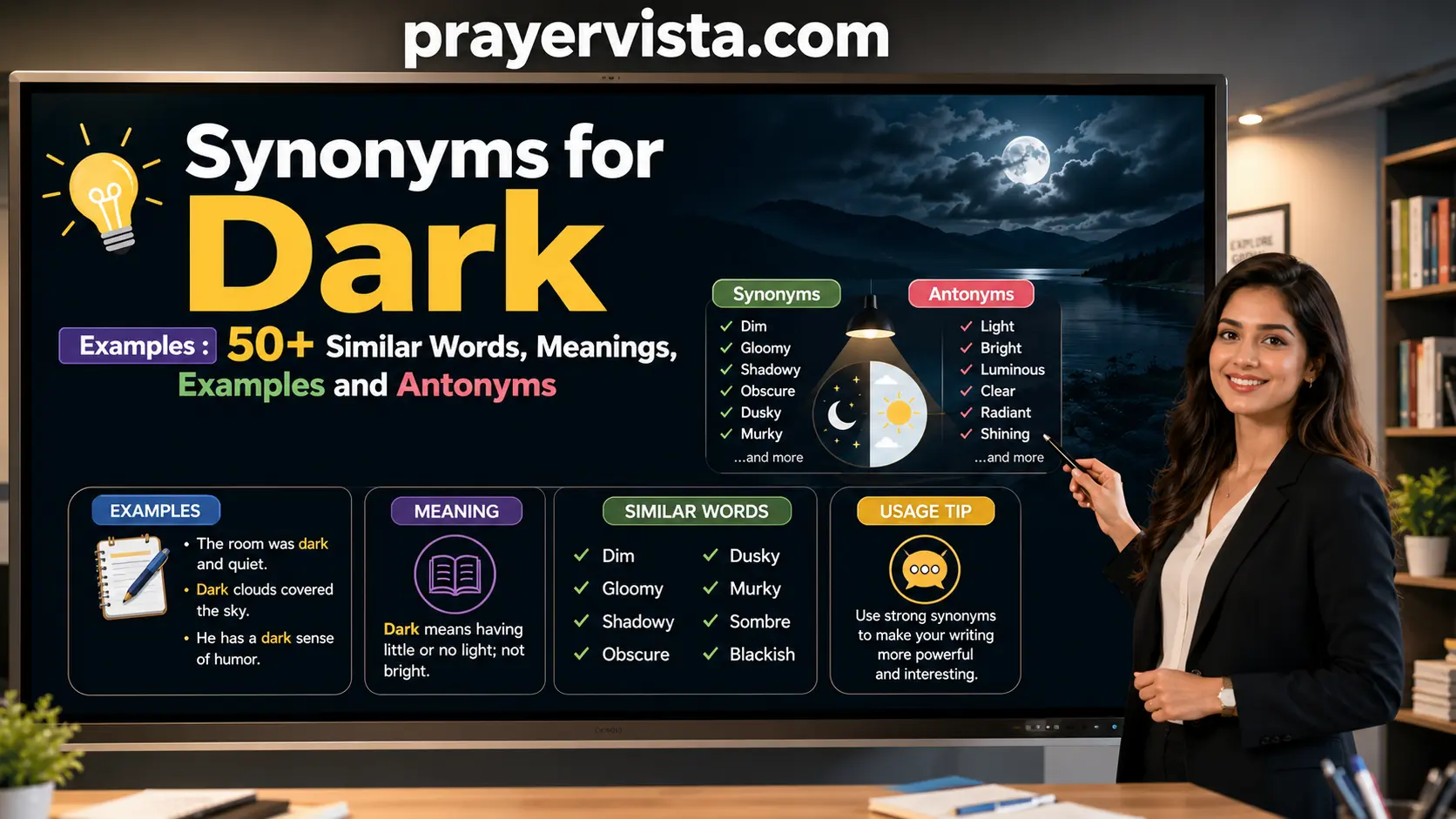
Synonyms for dark examples help you understand different words that can replace dark. They help you choose clearer and more accurate words in your writing. The meaning of dark changes with the context. It can describe low light, mystery, sadness, fear, evil, or a deep color. In this guide, you’ll find the best synonyms for dark. You will learn synonyms for dark evil, dark and gloomy, and dark and mysterious. This guide also covers poetic words for dark and dark antonyms. You will also learn their meanings, examples, and simple tips to choose the right word.
Introduction
Synonyms for dark examples help you understand different words that can replace dark. They show how to use more accurate and expressive words in different situations. The word dark can describe the absence of light, a deep color, mystery, sadness, fear, or evil. The word dark has many meanings. Learning the right synonyms improves your vocabulary and makes your writing more natural.
If you’re looking for synonyms for dark examples, you’ve come to the right place. This guide explains the best alternatives for dark. It includes simple meanings and examples. You will learn their parts of speech, pronunciation, collocations, antonyms, and real-life usage. You can write it in shorter sentences:
These synonyms help students, writers, English learners, and content creators. They improve vocabulary and make writing easier. They will also help you write clearly and avoid repeating the same word.
Creative writing also benefits from a richer vocabulary. Authors and poets use poetic words for dark to create strong images and emotions. Words like ebon, tenebrous, dusky, shadowy, and obsidian make writing more interesting. They add depth to stories, poems, and descriptions instead of repeating the word dark.
This comprehensive guide covers everything you need to know about synonyms for dark. You’ll discover 50+ synonyms for dark with their meanings and examples. You will learn parts of speech and related words. You will also find collocations, idioms, and dark synonym and antonym comparisons.
We’ll also explore dark antonyms, common mistakes, and usage tips. You will find answers to questions like “What is a better way to say dark?” and “What is a poetic synonym for darkness?” By the end, you will know the right synonym for every situation and use it naturally.
Table of Contents
- Introduction
- What Is Another Word for Dark?
- Meaning, Definition, and Parts of Speech of Dark
- Synonyms for Dark Examples in English
- Common Synonyms for Dark with Meanings and Examples
- Synonyms for Darkness Evil, Dark and Gloomy, and Dark and Mysterious
- Poetic Words for Dark and Beautiful Words with Dark Meanings
- Dark Synonym and Antonym
- Dark Antonyms and Opposite Words
- Collocations, Idioms, and Phrases with Dark
- Real-Life Examples of Dark Synonyms
- Common Mistakes When Using Dark Synonyms
- Tips for Choosing the Right Synonym for Dark
- Frequently Asked Questions
- Conclusion
What Is Another Word for Dark?

Another word for dark depends on the meaning and context. The word dark can describe little or no light, deep colors, mystery, sadness, fear, or evil. The right synonym makes your writing clearer. It helps you avoid repetition and express ideas better.
- Dim: Used for places, rooms, or lights that have a small amount of brightness.
- Shadowy: Used for things that are unclear, hidden, or covered with shadows.
- Gloomy: Describes dark moods, sad feelings, unpleasant weather, or depressing situations.
- Murky: Used for something dark, unclear, or difficult to understand.
- Tenebrous: A poetic word for deep darkness, mystery, or drama.
Meaning, Definition, and Parts of Speech of Dark
The word dark has different meanings depending on how it is used. It can describe lack of light, deep colors, mystery, sadness, or negative situations. Understanding its meaning helps you choose the right synonyms for dark.
- Definition: Dark means having little or no light. It can describe deep colors, hidden qualities, serious moods, or danger and evil.
- Meaning: The meaning of dark changes with context. It may refer to a dark room, a dark color, a dark secret, a dark mood, or a dark situation.
- Part of Speech: Dark is mainly an adjective. It describes nouns like dark night, dark clothes, and dark thoughts.
- Noun Usage: Dark can also be used as a noun. It refers to a place or condition without light, as in “the dark.”
- Figurative Meaning: Dark can show fear, sadness, mystery, or evil. It can also describe uncertainty or hidden things in writing and daily language.
Synonyms for Dark Examples in English
The English language offers many synonyms for dark, and each one has a unique meaning and purpose. Some words describe low light. Others express mystery, sadness, fear, deep colors, or danger. Understanding these differences helps you choose the most accurate word for every situation.
In this section, you’ll learn:
- Common and advanced synonyms for dark used in everyday and formal English.
- The meaning and usage of each synonym with clear explanations.
- Natural example sentences to understand how each word is used in context.
- Related words, antonyms, collocations, and common mistakes to improve your vocabulary.
- Practical tips and real-life examples help you use each synonym correctly. They improve your confidence in speaking and writing.
Synonyms for Darkness Evil
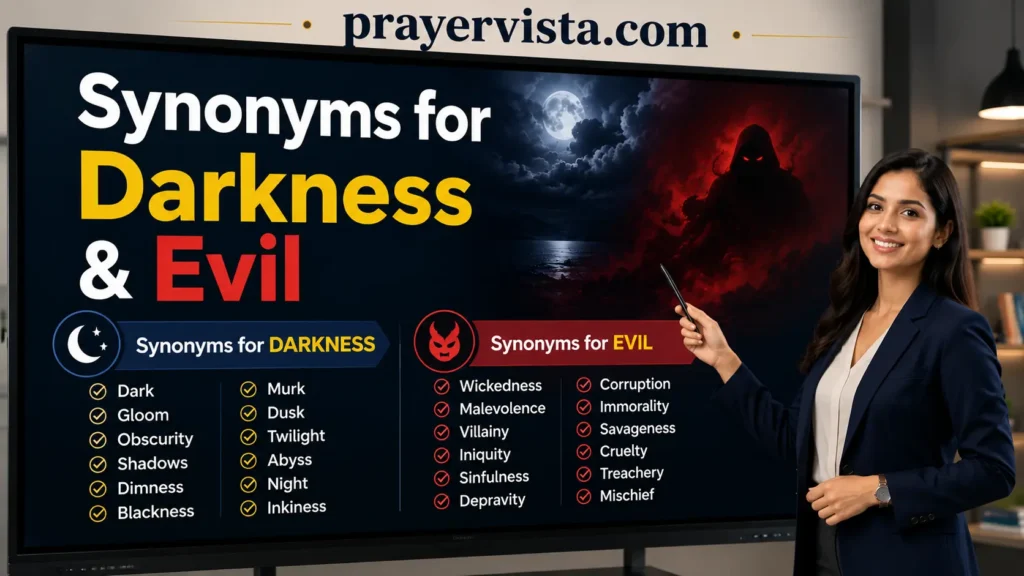
The word dark can sometimes describe negative qualities, harmful actions, or dangerous situations. These synonyms for darkness evil describe wickedness, threats, cruelty, or bad intentions. synonyms for darkness evil describe wickedness, threats, cruelty, and bad intentions. They are used for negative actions and harmful situations.
In this section, you’ll learn:
- Words that describe evil, wickedness, and harmful behavior.
- Synonyms used for dangerous people, actions, and situations.
- The difference between negative meanings and simple darkness.
- Examples showing how these words are used naturally.
- When to use these powerful words in writing and conversation.
Synonyms for Dark and Gloomy
The word dark can also show sadness, depression, or hopeless feelings. These synonyms for dark and gloomy describe serious moods, places, and situations.
In this section, you’ll learn:
- Words that describe sadness, dullness, and depressing feelings.
- Synonyms used for gloomy weather, places, and moods.
- How these words create emotional meaning in writing.
- The difference between physical darkness and emotional darkness.
- Examples that show the correct use of gloomy synonyms.
Synonyms for Dark and Mysterious
The word dark is often used to create a feeling of mystery, secrecy, or uncertainty. These synonyms for dark and mysterious are useful in creative writing. They help create suspense, mystery, and imagination.
In this section, you’ll learn:
- Words that describe mystery, hidden things, and unknown situations.
- Synonyms used for mysterious places, characters, and events.
- How writers use these words to create suspense.
- The difference between mysterious darkness and physical darkness.
- Natural examples from creative and everyday contexts.
Poetic Words for Dark and Beautiful Words with Dark Meanings
Writers and poets often choose elegant alternatives to dark to create stronger imagery and deeper emotions. These words can make descriptions more vivid, expressive, and memorable while adding a literary touch to your writing.
In this section, you’ll learn:
- Popular poetic words for dark used in literature and poetry.
- Beautiful words with dark meanings and their symbolism.
- How these words differ from everyday synonyms.
- Examples from creative and descriptive writing.
- Tips for using poetic vocabulary naturally and effectively.
Dark Synonym and Antonym
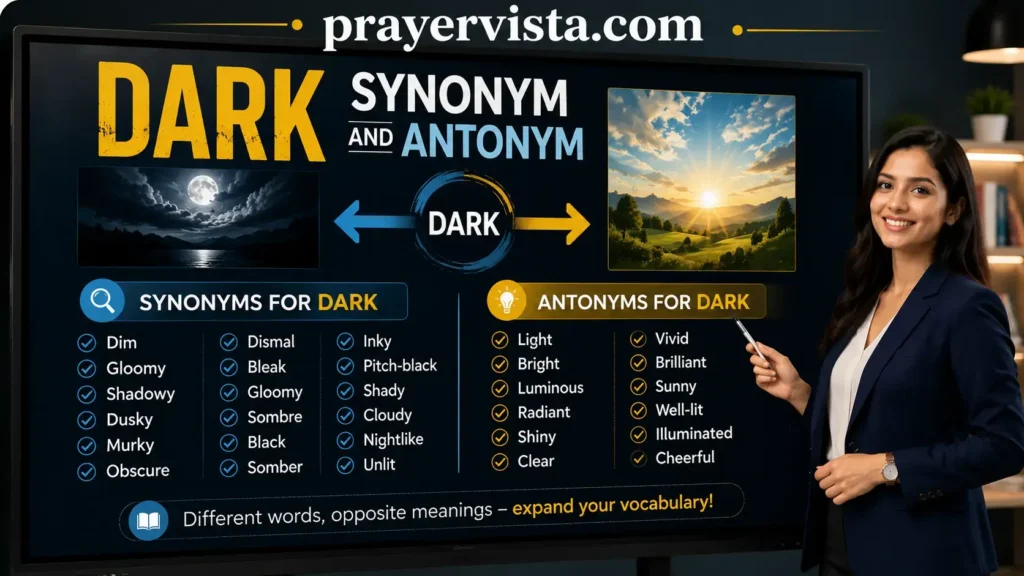
Understanding both synonyms and antonyms of dark gives you a complete picture of the word’s meaning. Knowing the opposite of a word helps you choose the most suitable expression and improves both your writing and speaking skills.
In this section, you’ll learn:
- The most common synonyms and antonyms of dark.
- How opposite words change the meaning of a sentence.
- When to use a synonym instead of an antonym.
- Common comparisons between similar and opposite words.
- Examples that show the correct usage in different contexts.
Dark Antonyms and Opposite Words
Every word has an opposite that expresses a contrasting meaning, and dark is no exception. Depending on the context, different antonyms may be more suitable than others, whether you’re describing light, color, mood, or clarity.
In this section, you’ll learn:
- The most common antonyms of dark in English.
- Differences between words such as bright, light, radiant, and luminous.
- The best contexts for using each opposite word.
- Example sentences that highlight the contrast.
- Tips for selecting the right antonym in everyday writing.
Collocations, Idioms, and Phrases with Dark
The word dark appears in many common collocations, idioms, and phrases that make English more natural and expressive. Learning these expressions helps you understand native speakers and use the word dark more confidently in different contexts.
| Category | What You’ll Learn |
| Collocations | Common word combinations used with dark in everyday English. |
| Idioms | Popular idioms and expressions related to dark and darkness. |
| Meanings | Simple explanations of each collocation and idiom. |
| Examples | Natural example sentences showing correct usage. |
| Usage Tips | Common mistakes to avoid and tips for using these expressions correctly. |
Real-Life Examples of Dark Synonyms
Learning through real-life examples makes it easier to understand when and where each dark synonym should be used. These examples show how different words fit naturally into conversations, literature, academic writing, and everyday situations.
| Example Type | What You’ll Learn |
| Everyday English | How dark synonyms are used in daily conversations. |
| Literature | Examples from novels, poems, and creative writing. |
| Professional Writing | Usage in news articles, reports, and formal communication. |
| Context-Based Usage | How the meaning changes depending on the situation. |
| Writing Tips | Practical examples you can apply in your own speaking and writing. |
List of Synonyms for Dark
Common Synonyms for Dark
1. Dim
Meaning: Having only a small amount of light; not bright.
Example: The café’s dim lighting created a warm and relaxing atmosphere.
2. Shadowy
Meaning: Filled with shadows or difficult to see clearly.
Example: A shadowy path disappeared into the quiet forest after sunset.
3. Gloomy
Meaning: Dark, depressing, or lacking happiness.
Example: The gloomy sky suggested that heavy rain was approaching.
4. Murky
Meaning: Dark, cloudy, dirty, or difficult to understand.
Example: The journalist investigated the company’s murky financial dealings.
5. Dusky
Meaning: Slightly dark, especially during the evening.
Example: The beach looked peaceful beneath the dusky evening sky.
6. Obscure
Meaning: Difficult to see, understand, or recognize.
Example: The professor explained an obscure scientific theory using simple language.
7. Pitch-black
Meaning: Completely dark with no visible light.
Example: The hiking trail became pitch-black after the sun disappeared behind the mountains.
8. Lightless
Meaning: Without any natural or artificial light.
Example: The explorers carefully entered the lightless cave with flashlights.
9. Shady
Meaning: Protected from direct sunlight or slightly dark because of shade.
Example: We enjoyed our lunch beneath a shady oak tree in the park.
10. Dull
Meaning: Lacking brightness, shine, or vivid color.
Example: The old painting looked dull until it was professionally restored.
11. Inky
Meaning: Extremely dark, like the color of black ink.
Example: The ocean reflected the inky night sky beneath the full moon.
12. Black
Meaning: The darkest color or completely dark in appearance.
Example: She selected a black evening dress for the formal dinner.
13. Cloudy
Meaning: Covered with clouds or lacking brightness.
Example: A cloudy afternoon made the countryside look peaceful and cool.
14. Faint
Meaning: Weak, slight, or barely visible.
Example: We noticed a faint glow coming from a distant farmhouse.
15. Twilight
Meaning: The soft natural light between sunset and night.
Example: The children rode their bicycles home during twilight.
16. Tenebrous
Meaning: Extremely dark, mysterious, or difficult to understand.
Example: The fantasy novel describes a tenebrous kingdom hidden beyond ancient mountains.
17. Ebon
Meaning: Deep black in color; commonly used in poetry and literary writing.
Example: The queen’s ebon hair shimmered beautifully under the palace lights.
18. Jet-black
Meaning: Completely black with a rich, glossy appearance.
Example: The luxury sports car featured a stunning jet-black finish.
19. Unlit
Meaning: Without lights turned on.
Example: The unlit street became completely silent after midnight.
20. Opaque
Meaning: Not allowing light to pass through.
Example: The conference room used opaque glass walls to ensure privacy.
Comparison Table of Common Synonyms for Dark
| Synonym | Meaning | Best Used For | Closest Antonym | Example Context |
| Dim | Slightly dark | Rooms and lighting | Bright | A dim café |
| Gloomy | Dark and depressing | Mood and weather | Cheerful | A gloomy morning |
| Murky | Dark or unclear | Water and confusing situations | Clear | Murky water |
| Dusky | Soft evening darkness | Nature and landscapes | Radiant | Dusky sky |
| Pitch-black | Completely dark | Total darkness | Well-lit | Pitch-black cave |
| Tenebrous | Deeply dark and mysterious | Literary writing | Luminous | Tenebrous forest |
| Opaque | Blocking light | Materials and glass | Transparent | Opaque window |
Poetic and Literary Synonyms for Dark

Poets and authors often use poetic words for dark to create vivid imagery, mystery, and emotion. Unlike common synonyms, these words add elegance and depth to stories, poems, novels, and descriptive writing. They are especially useful when you want to paint a memorable picture with your words or create a dramatic atmosphere.
21. Umbral
Meaning: Relating to shadows or darkness.
Example: The ancient castle stood beneath an umbral sky as night slowly approached.
22. Nocturnal
Meaning: Active or occurring during the night.
Example: Owls are nocturnal birds that hunt after sunset.
23. Twilighted
Meaning: Covered in the soft light of twilight or fading daylight.
Example: The twilighted valley looked peaceful as the sun disappeared.
24. Crepuscular
Meaning: Relating to twilight or active during dawn and dusk.
Example: Bats are crepuscular animals that become active in the evening.
25. Sable
Meaning: Deep black or very dark in color.
Example: The queen wore a sable cloak during the royal ceremony.
26. Obsidian
Meaning: Black like volcanic glass; intensely dark and glossy.
Example: The lake reflected the obsidian night sky.
27. Stygian
Meaning: Extremely dark, gloomy, or hellish.
Example: The travelers crossed a Stygian forest filled with silence.
28. Cimmerian
Meaning: Completely dark or shrouded in deep darkness.
Example: Thick clouds covered the mountains in Cimmerian darkness.
29. Starless
Meaning: Without visible stars in the sky.
Example: The campers spent the night beneath a starless sky.
30. Moonless
Meaning: Without the light of the moon.
Example: The hikers continued their journey on a moonless night.
31. Night-cloaked
Meaning: Hidden or covered by the darkness of night.
Example: The village remained night-cloaked until dawn.
32. Shadow-filled
Meaning: Full of shadows or shaded areas.
Example: The old library contained shadow-filled corners that felt mysterious.
33. Gloaming
Meaning: The period of twilight just after sunset.
Example: Birds returned to their nests during the gloaming.
34. Dusk-like
Meaning: Resembling the soft darkness of dusk.
Example: The room had a dusk-like glow from the warm lamps.
35. Raven-black
Meaning: Deep black like the feathers of a raven.
Example: Her raven-black hair flowed in the gentle breeze.
Comparison Table of Poetic and Literary Synonyms for Dark
| Synonym | Meaning | Best Used For | Closest Antonym | Example Context |
| Umbral | Related to shadows | Poetry and literature | Radiant | Umbral forest |
| Crepuscular | Related to twilight | Nature and wildlife | Daytime | Crepuscular animals |
| Sable | Deep black | Clothing and descriptive writing | Snow-white | Sable cloak |
| Obsidian | Glossy black | Nature and objects | Crystal-clear | Obsidian sky |
| Stygian | Extremely dark and gloomy | Fantasy and horror | Luminous | Stygian cave |
| Gloaming | Twilight after sunset | Poetry and storytelling | Sunrise | Evening gloaming |
| Raven-black | Rich, deep black | Hair, feathers, and colors | Golden | Raven-black hair |
Synonyms for Dark, Gloomy, Mysterious, and Evil
Some synonyms for dark describe more than the absence of light. They can express mystery, danger, sadness, fear, or evil. These words are common in literature, movies, news reports, and everyday English when describing emotions, people, places, or situations.
36. Sooty
Meaning: Covered with or resembling black soot.
Example: The old brick chimney had sooty walls after years of use.
37. Charcoal
Meaning: Dark gray or black, like burned wood.
Example: He chose a charcoal suit for the business meeting.
38. Onyx
Meaning: Deep glossy black, like the gemstone.
Example: The necklace featured polished onyx stones.
39. Ebony
Meaning: Very dark black, often referring to wood or color.
Example: The cabinet was crafted from rich ebony wood.
40. Sinister
Meaning: Suggesting evil, danger, or harmful intentions.
Example: The stranger’s sinister smile made everyone feel uneasy.
41. Ominous
Meaning: Giving the impression that something bad is about to happen.
Example: The ominous thunderclouds quickly covered the city.
42. Bleak
Meaning: Cold, empty, depressing, or without hope.
Example: The abandoned village looked bleak during the winter.
43. Somber
Meaning: Dark in color or serious in mood.
Example: Everyone remained somber during the memorial service.
44. Dreary
Meaning: Dull, gloomy, and lacking excitement.
Example: The long, dreary afternoon seemed never to end.
45. Melancholy
Meaning: Feeling or expressing deep sadness.
Example: A melancholy melody echoed through the quiet hall.
46. Forbidding
Meaning: Looking unfriendly, threatening, or difficult to approach.
Example: The castle stood on a forbidding cliff overlooking the sea.
47. Malevolent
Meaning: Having or showing a desire to cause harm.
Example: The story’s villain had a malevolent plan to seize the kingdom.
48. Fiendish
Meaning: Extremely cruel, wicked, or difficult.
Example: The detective solved the fiendish puzzle before sunrise.
49. Wicked
Meaning: Morally wrong, evil, or harmful.
Example: The fairy tale warned children about a wicked witch.
50. Foreboding
Meaning: A feeling that something bad is likely to happen.
Example: The silence before the storm created a sense of foreboding.
Comparison Table of Dark, Gloomy, Mysterious, and Evil Synonyms
| Synonym | Meaning | Best Used For | Closest Antonym | Example Context |
| Sinister | Suggesting evil or danger | Mystery and thrillers | Friendly | Sinister smile |
| Ominous | Warning of trouble | Weather and suspense | Promising | Ominous clouds |
| Bleak | Hopeless or depressing | Places and emotions | Hopeful | Bleak landscape |
| Somber | Serious or dark | Mood and ceremonies | Cheerful | Somber gathering |
| Malevolent | Intentionally harmful | Villains and fiction | Benevolent | Malevolent ruler |
| Wicked | Evil or morally wrong | Fairy tales and stories | Virtuous | Wicked witch |
| Foreboding | Feeling that something bad will happen | Atmosphere and emotions | Reassuring | Foreboding silenc |
Common Mistakes When Using Dark Synonyms
Although many synonyms for dark have similar meanings, they are not always interchangeable. Using the wrong synonym can change the meaning of a sentence or make your writing sound unnatural. Understanding these common mistakes will help you use dark synonyms more accurately and confidently.
- Mistake:
- Using dim to describe complete darkness. | Correct Usage: Use pitch-black or lightless when there is no light at all.
- Mistake: Using gloomy only for lighting. | Correct Usage: Gloomy is more commonly used to describe weather, mood, or atmosphere.
- Mistake: Confusing murky with muddy. | Correct Usage: Murky can describe both dark water and unclear situations, while muddy mainly refers to dirt or mud.
- Mistake: Using opaque as a synonym for darkness. | Correct Usage: Opaque means not transparent and describes materials rather than lighting conditions.
- Mistake: Using nocturnal as a synonym for dark. | Correct Usage: Nocturnal describes animals or activities that occur at night, not darkness itself.
- Mistake: Using literary words like Stygian in everyday conversation. | Correct Usage: Reserve highly literary words for poetry, fiction, or formal writing.
- Mistake: Repeating the word dark too often. | Correct Usage: Replace it with suitable synonyms such as dim, dusky, gloomy, shadowy, or murky, depending on the context.
Tips for Choosing the Right Synonym for Dark

Choosing the correct synonym for dark depends on the meaning, situation, and tone of your writing. The right word can make your sentences clearer, more natural, and more expressive.
- Consider the context: Use dim or unlit for places with little light, while gloomy or bleak are better for moods, feelings, and situations.
- Match the tone: Use simple words like shadowy or dim in everyday writing and choose poetic words like tenebrous or ebon for creative writing.
- Understand the meaning: Some synonyms describe physical darkness, while others describe mystery, sadness, or danger. Choose a word that matches your exact idea.
- Choose the right level of formality: Words like obscure and somber work well in formal writing, while rare literary words are better for stories and poetry.
- Avoid repetition: Instead of using dark again and again, replace it with suitable synonyms to make your writing more engaging and varied.
FAQs
What is a better way to say “dark”?
A better way to say dark depends on the context and meaning. Common alternatives include dim, shadowy, gloomy, murky, dusky, obscure, and pitch-black. For poetic or creative writing, words like tenebrous, ebon, and Stygian can create a deeper feeling of mystery and emotion.
What is a poetic synonym for darkness?
Some poetic synonyms for darkness include gloaming, umbral, tenebrous, Stygian, Cimmerian, ebon, and moonless. These words are often used in poems and literature to describe night, mystery, sadness, or dramatic scenes.
What are some dark idioms?
Common dark idioms include:
- In the dark — to be unaware of something.
- A shot in the dark — a random guess or attempt.
- Dark horse — a person who unexpectedly succeeds.
- After dark — after sunset.
- Keep someone in the dark — to hide information from someone.
- Dark days — a difficult or unhappy period.
What are cool, dark words?
Some cool and powerful dark words include obsidian, onyx, tenebrous, shadowy, raven-black, Stygian, midnight, ebon, and nocturnal. These words are popular in fantasy writing, poetry, storytelling, and artistic descriptions.
What are synonyms for darkness evil?
Synonyms related to darkness and evil include sinister, malevolent, wicked, fiendish, ominous, threatening, and foreboding. These words describe danger, harmful intentions, or negative energy rather than simple lack of light.
What are synonyms for dark and gloomy?
Common synonyms for dark and gloomy include bleak, somber, dreary, melancholy, shadowy, murky, and dismal. These words are useful for describing sad emotions, unpleasant weather, depressing places, or serious situations.
What are synonyms for dark and mysterious?
Synonyms for dark and mysterious include shadowy, obscure, cryptic, enigmatic, secretive, hidden, tenebrous, and unknown. These words are often used for mysterious characters, places, secrets, and stories.
What are dark antonyms?
The main antonyms of dark are bright, light, radiant, luminous, clear, sunny, illuminated, and glowing. These words describe the presence of light, visibility, or a cheerful atmosphere.
What is a dark synonym and antonym?
A dark synonym is a word with a similar meaning, such as dim, gloomy, shadowy, or pitch-black. A dark antonym is a word with the opposite meaning, such as bright, clear, radiant, or illuminated.
What are beautiful words with dark meanings?
Some beautiful words with dark meanings include gloaming (the fading light after sunset), ebon (deep black), obsidian (glossy black), nocturnal (related to night), and tenebrous (deeply dark and mysterious). These words add elegance and imagery to creative writing.
What are synonyms of dark?
Common synonyms of dark include dim, shadowy, gloomy, murky, dusky, obscure, black, unlit, tenebrous, ebon, and pitch-black. The best synonym depends on whether you are describing light, color, mood, mystery, or danger.
Final Thoughts
The word dark has many meanings beyond the absence of light. Dark can describe colors, places, emotions, mystery, sadness, danger, or evil. Choosing the right synonym for dark makes your writing clearer and more expressive. Dim, shadowy, gloomy, murky, and dusky are common synonyms for dark. They work well for describing light, weather, and surroundings. Tenebrous, ebon, umbral, and Stygian are more poetic choices. They add beauty, depth, and a sense of mystery to creative writing.
Synonyms for dark and gloomy help you describe sad moods and serious situations. They also work well for depressing environments. Shadowy, obscure, cryptic, and enigmatic are synonyms for dark and mysterious. They suit stories, novels, and suspenseful writing. Sinister, ominous, malevolent, and wicked are synonyms for darkness and evil. They express danger or harmful intentions.
Learning dark synonym and antonym pairs also improves vocabulary. Bright, radiant, luminous, and illuminated are common antonyms for dark. They represent light, hope, and clarity. Studying synonyms for dark helps you choose the right word for every situation. This includes their meanings and correct usage.
Beautiful dark words work well for poetry. Simple alternatives work well for everyday communication. The right synonym makes your English more natural, accurate, and powerful.
Discover Related Expert Guides…..
- Synonyms for Good Examples : A Guide to Enriching Vocabulary
- Easy Synonyms for Light Examples in Daily English Writing
- Synonyms for Enemy: 50+ Alternatives to Use in Every Context
- Top 100+ Synonyms for Hot Examples: With Real-Life Examples

Hi, I’m Sophia Reynolds, a content writer at Prayervista.com. I love writing clear and engaging content about synonyms and vocabulary. My goal is to help readers understand word meanings, improve their English, and choose the right words with confidence through simple and accurate explanations.