Quick Summary
This Synonyms for Slow PDF in English introduces 50 useful synonyms for slow, along with simple meanings and correct example sentences to improve your vocabulary. It explains what is a better word for slow, how to say slow professionally, and the slow-moving meaning using clear, practical examples. You’ll also discover slow synonyms and antonyms, as well as positive and formal alternatives for different situations. Comparison tables and FAQs make it easy to understand when to use each synonym correctly. Keep this Synonyms for Slow PDF as a valuable reference to strengthen your English writing, speaking, and communication skills.
An Introduction to Synonyms for Slow
Synonyms for slow PDF are a helpful resource for anyone who wants to improve their English vocabulary. It explains different words that can replace slow, their meanings, when to use them, and how they change the tone of a sentence. Whether you are a student, teacher, writer, or English learner, understanding these alternatives will make your writing and speaking more natural.
The word slow has several meanings. It can describe speed, movement, learning ability, progress, technology, growth, or even music. Because of these different meanings, there is no single synonym that works in every situation. Choosing the right word depends on the context.
This synonyms for slow PDF guide brings together common, formal, academic, and everyday alternatives. You will also learn the differences between similar words, discover their parts of speech, see real-life examples, and avoid common mistakes that many English learners make.
Imagine describing a traffic jam. Instead of saying, “The traffic was slow,” you might say it was sluggish, crawl-like, or moving at a snail’s pace. If you are writing a business report, you may prefer words like gradual, deliberate, or steady. Using the right synonym makes your writing more accurate and engaging.
In this complete guide, you’ll learn slow synonyms and antonyms, professional alternatives, positive words for slow, common collocations, idioms, and practical examples. By the end, you’ll know exactly what is a better word for slow and how to use each synonym with confidence.
Table of Contents
- Quick summary
- An Introduction to Synonyms for Slow
- What Does Slow Mean?
- What Is a Better Word for Slow?
- How to Choose the Right Synonym
- Common Situations Where “Slow” Is Used
- Top Slow Synonyms with Meanings
- Slow Synonyms Comparison Table
- Professional and Academic Alternatives
- Positive Synonyms for Slow
- Slow Synonyms and Antonyms
- Common Idioms with Slow
- FAQs
- Conclusion
What Does Slow Mean?

According to leading English dictionaries such as Merriam-Webster and Cambridge Dictionary, slow generally means:
- Moving at a low speed
- Taking a long time
- Not happening quickly
- Showing little progress
- Learning or understanding more slowly than expected
- Gentle, careful, or deliberate
Because slow has many meanings, English offers dozens of alternatives. Some are positive, while others may sound negative or critical.
Examples
- The bus was slow because of heavy traffic.
- Business growth has been slow this year.
- She speaks slowly and clearly.
- The internet connection is slow today.
- He made slow but steady progress.
Each sentence could use a different synonym depending on the exact meaning.
Why Learn Synonyms for Slow?
Learning synonyms helps you:
- Improve your vocabulary
- Avoid repeating the same word
- Write more naturally
- Speak more confidently
- Score better in English exams
- Create professional documents
- Write SEO-friendly articles
- Understand books more easily
Writers, bloggers, students, and professionals all benefit from using precise vocabulary instead of repeating slowly over and over.
What Is a Better Word for Slow?
There isn’t one perfect replacement for slow. The best synonym depends on the situation.
Here are some of the most useful alternatives.
| Synonym | Best Used For | Tone |
| Gradual | Progress or change | Positive |
| Steady | Continuous movement | Positive |
| Sluggish | Poor performance | Negative |
| Leisurely | Relaxed movement | Positive |
| Deliberate | Careful actions | Professional |
| Unhurried | Calm pace | Positive |
| Measured | Controlled pace | Formal |
| Cautious | Careful decisions | Professional |
| Lagging | Falling behind | Negative |
| Crawling | Extremely slow movement | Informal |
Notice how every word creates a slightly different meaning. That is why choosing the right synonym is important.
How to Choose the Right Synonym
Before replacing slow, ask yourself these questions.
Is it about speed?
Use words like:
- Slow-moving
- Sluggish
- Crawling
- Leisurely
Example:
The traffic was crawling after the accident.
Is it about careful work?
Choose:
- Deliberate
- Measured
- Methodical
- Thoughtful
Example:
She made a deliberate decision after reviewing all the facts.
Is it about progress?
Good choices include:
- Gradual
- Steady
- Incremental
- Progressive
Example:
Sales showed gradual improvement throughout the year.
Is it about technology?
Suitable words include:
- Lagging
- Unresponsive
- Delayed
- Sluggish
Example:
My laptop has become sluggish after installing several new programs.
Common Situations Where “Slow” Is Used

Understanding context helps you select the perfect synonym.
Slow Movement
Examples include:
- Walking
- Driving
- Running
- Traffic
- Rivers
- Animals
Best synonyms:
- Leisurely
- Unhurried
- Crawling
- Plodding
- Measured
Slow Learning
Examples:
- Students
- Children
- Training
- Understanding
Better choices:
- Developing gradually
- Learning at their own pace
- Needs additional support
Instead of labeling someone as slow, modern English encourages respectful language.
For example:
❌ He is slow.
✅ He learns at his own pace.
Slow Internet
Common replacements:
- Lagging
- Delayed
- Sluggish
- Unresponsive
Example:
The network became sluggish during peak hours.
Slow Business Growth
Professional alternatives include:
- Gradual
- Steady
- Moderate
- Incremental
Example:
The company experienced steady growth over the last quarter.
Slow Music
Possible replacements:
- Gentle
- Relaxing
- Calm
- Soft
- Moderate-tempo
Example:
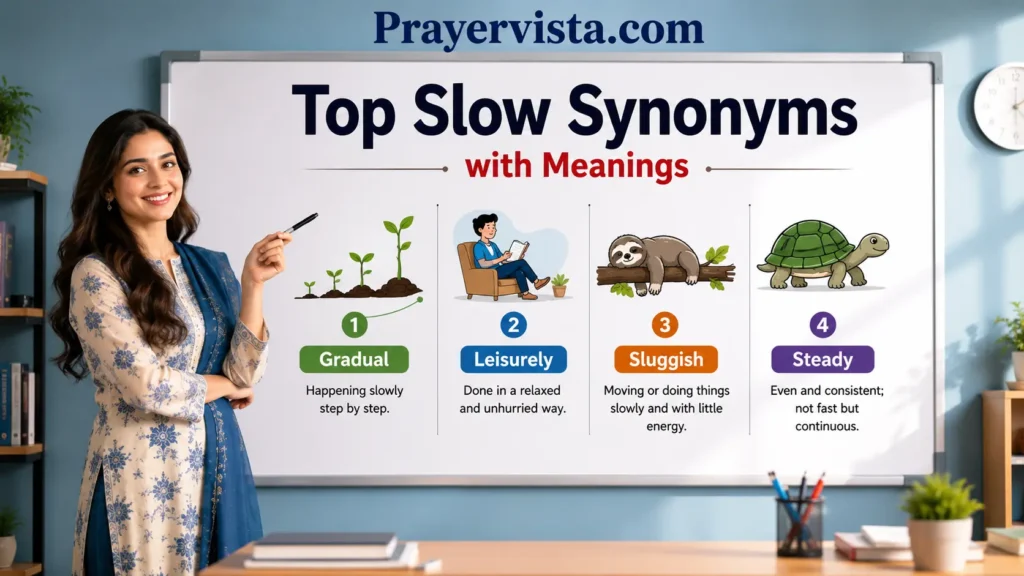
Top Slow Synonyms with Meanings
They played gentle music during dinner.
Common Synonyms for Slow
1. Gradual
Meaning: Happening little by little over time.
Example: The weather showed a gradual change during the week.
2. Leisurely
Meaning: Moving in a relaxed and unhurried way.
Example: We enjoyed a leisurely walk along the beach.
3. Sluggish
Meaning: Moving or responding more slowly than usual.
Example: My computer became sluggish after the update.
4. Steady
Meaning: Moving at a constant and even pace.
Example: The train made steady progress through the mountains.
5. Measured
Meaning: Done in a careful and controlled way.
Example: She spoke in a measured voice during the meeting.
6. Deliberate
Meaning: Done slowly and carefully on purpose.
Example: He took a deliberate approach to solving the problem.
7. Unhurried
Meaning: Done without rushing.
Example: The guide gave us an unhurried tour of the museum.
8. Moderate
Meaning: Moving or happening at an average speed.
Example: The car continued at a moderate speed.
9. Gentle
Meaning: Slow, calm, and not forceful.
Example: A gentle breeze cooled the afternoon.
10. Relaxed
Meaning: Done at an easy and comfortable pace.
Example: They spent a relaxed afternoon by the lake.
11. Calm
Meaning: Moving or happening without hurry or excitement.
Example: She answered every question in a calm manner.
12. Methodical
Meaning: Done in a careful, organized, and slow way.
Example: The scientist followed a methodical process during the experiment.
13. Patient
Meaning: Willing to take time without becoming upset.
Example: The teacher remained patient while explaining the lesson.
14. Careful
Meaning: Done slowly to avoid mistakes or danger.
Example: Please be careful when crossing the busy road.
15. Thoughtful
Meaning: Showing careful consideration before acting.
Example: She gave a thoughtful response to the difficult question.
Comparison Table: Common Synonyms for Slow
| Synonym | Meaning | Best Used For | Antonym |
|---|---|---|---|
| Gentle | Calm and not forceful | Weather, movement | Harsh |
| Relaxed | Free from hurry | Lifestyle, travel | Tense |
| Moderate | Average or reasonable speed | Driving, exercise | Extreme |
| Careful | Done with attention | Tasks, safety | Careless |
| Thoughtful | Done with consideration | Decisions, responses | Thoughtless |
Quick Comparison
- Gradual focuses on slow change over time.
- Leisurely describes a relaxed pace without rushing.
- Sluggish usually has a negative meaning and suggests poor performance.
- Steady highlights consistent and reliable progress.
- Measured emphasizes careful and controlled actions rather than speed alone.
Professional Synonyms for Slow
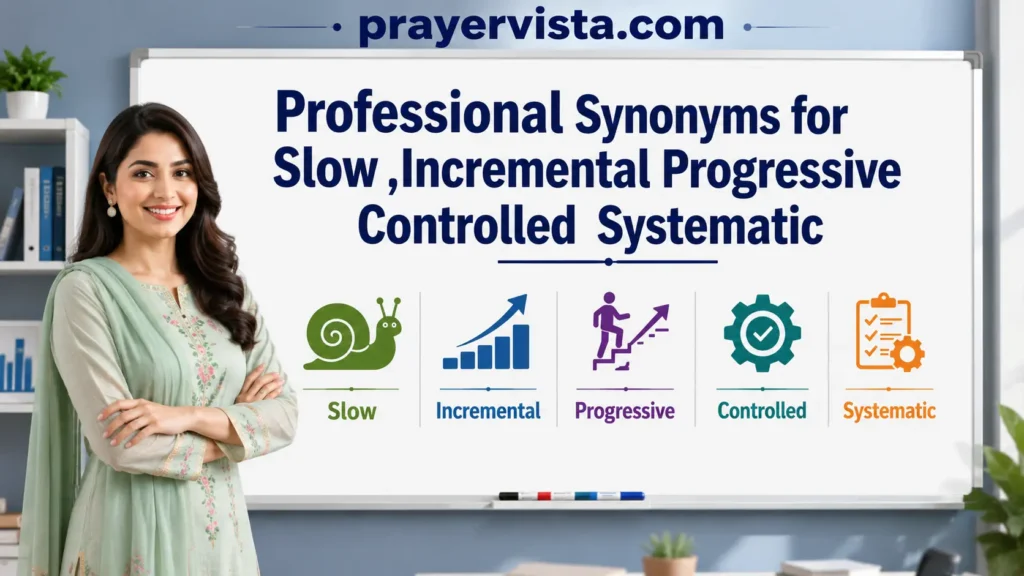
16. Incremental
Meaning: Happening in small, gradual steps.
Example: The project made incremental progress every month.
17. Progressive
Meaning: Developing slowly over time.
Example: The company achieved progressive growth this year.
18. Systematic
Meaning: Done in an organized and careful way.
Example: She used a systematic approach to complete the task.
19. Controlled
Meaning: Done in a calm and regulated manner.
Example: The driver kept the car at a controlled speed.
20. Consistent
Meaning: Continuing at a steady pace without sudden changes.
Example: His consistent effort improved his skills.
21. Cautious
Meaning: Acting carefully to avoid mistakes or risks.
Example: The investor took a cautious approach to spending.
22. Calculated
Meaning: Planned carefully before taking action.
Example: She made a calculated decision after reviewing the facts.
23. Gradualistic
Meaning: Developing through slow and steady change.
Example: The reforms followed a gradualistic process.
24. Purposeful
Meaning: Moving slowly with a clear goal in mind.
Example: He walked with a purposeful pace toward the office.
25. Paced
Meaning: Moving at a controlled speed.
Example: The lesson was paced well for beginners.
26. Moderated
Meaning: Kept at a balanced or reduced speed.
Example: The speaker used a moderated tone throughout the presentation.
27. Reserved
Meaning: Calm and not rushed in behavior.
Example: She gave a reserved response during the interview.
28. Disciplined
Meaning: Done with patience and careful control.
Example: His disciplined work habits produced excellent results.
29. Balanced
Meaning: Moving at a stable and well-managed pace.
Example: The team maintained a balanced workflow.
30. Conservative
Meaning: Avoiding unnecessary speed or risk.
Example: The company adopted a conservative growth strategy.
Comparison Table: Professional Synonyms for Slow
| Synonym | Meaning | Best Used For | Antonym |
|---|---|---|---|
| Calculated | Carefully planned | Business, finance | Reckless |
| Controlled | Managed carefully | Driving, operations | Uncontrolled |
| Disciplined | Following a careful routine | Work, study | Undisciplined |
| Balanced | Stable and even | Workload, lifestyle | Unbalanced |
| Purposeful | Moving with clear intention | Leadership, planning | Aimless |
Quick Comparison
- Incremental emphasizes small improvements over time.
- Systematic focuses on organization and careful planning.
- Controlled describes regulated and steady actions.
- Consistent highlights reliable progress without interruptions.
- Cautious refers to careful actions taken to avoid mistakes or risks
Very Slow Synonyms
31. Crawling
Meaning: Moving extremely slowly.
Example: Traffic was crawling during rush hour.
32. Plodding
Meaning: Moving slowly with steady effort.
Example: The hikers kept a plodding pace up the hill.
33. Lagging
Meaning: Falling behind or moving more slowly than others.
Example: Internet speed was lagging during the video call.
34. Dragging
Meaning: Moving or progressing very slowly.
Example: The meeting was dragging into the evening.
35. Slothful
Meaning: Moving slowly because of laziness.
Example: His slothful habits affected his work.
36. Lumbering
Meaning: Moving slowly with heavy or awkward steps.
Example: The elephant made a lumbering walk across the field.
37. Poky
Meaning: Very slow, especially in an annoying way.
Example: This old computer is poky compared to newer models.
38. Snail-like
Meaning: As slow as a snail.
Example: The queue moved at a snail-like pace.
39. Tardy
Meaning: Slow because something is late.
Example: The train was tardy due to bad weather.
40. Dawdling
Meaning: Wasting time by moving too slowly.
Example: Stop dawdling and finish your homework.
Comparison Table: Very Slow Synonyms
| Synonym | Meaning | Best Used For | Antonym |
|---|---|---|---|
| Dragging | Continuing too slowly | Meetings, events | Flying |
| Lumbering | Heavy and slow movement | Animals, vehicles | Agile |
| Poky | Annoyingly slow | Devices, people | Speedy |
| Snail-like | Extremely slow | Queues, traffic | Rapid |
| Slothful | Slow because of laziness | Behavior | Energetic |
Quick Comparison
- Crawling means moving extremely slowly.
- Lagging suggests falling behind others.
- Plodding shows steady effort despite slow speed.
- Tardy refers to being late.
- Dawdling means wasting time by moving too slowly.
Positive and Neutral Synonyms for Slow
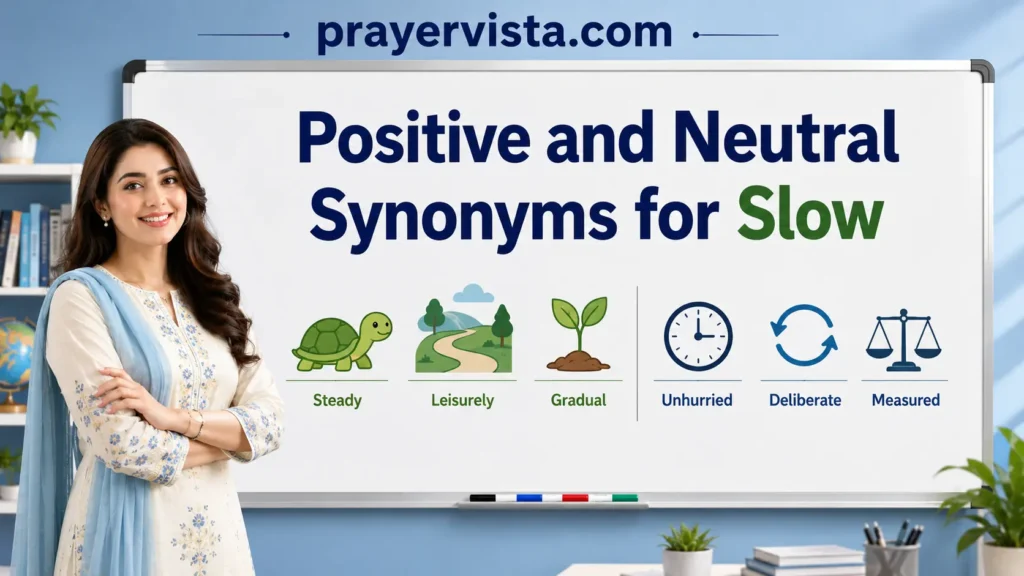
41. Easygoing
Meaning: Relaxed and not in a hurry.
Example: He has an easygoing personality and never rushes.
42. Peaceful
Meaning: Calm, quiet, and free from stress or hurry.
Example: We spent a peaceful afternoon by the lake.
43. Smooth
Meaning: Moving gently without sudden stops or changes.
Example: The car had a smooth ride on the highway.
44. Mindful
Meaning: Acting carefully with full attention.
Example: She made a mindful decision after thinking carefully.
45. Gentle-paced
Meaning: Moving at a calm and comfortable speed.
Example: The tour followed a gentle-paced schedule.
46. Even
Meaning: Continuing at a steady and regular pace.
Example: The runner maintained an even pace throughout the race.
47. Unrushed
Meaning: Done without pressure or haste.
Example: We enjoyed an unrushed breakfast before leaving.
48. Calm
Meaning: Free from hurry or excitement.
Example: She remained calm during the discussion.
49. Deliberate
Meaning: Done slowly and carefully on purpose.
Example: The engineer took a deliberate approach to solving the problem.
50. Patient
Meaning: Willing to wait or work without rushing.
Example: A patient teacher helps students understand difficult lessons.
Comparison Table: Positive and Neutral Synonyms for Slow
| Synonym | Meaning | Best Used For | Antonym |
|---|---|---|---|
| Unhurried | Done without rushing | Conversations, daily activities | Rushed |
| Measured | Calm and controlled | Professional communication | Impulsive |
| Methodical | Organized and careful | Research, work, learning | Haphazard |
| Mindful | Acting with care and attention | Decisions, daily life | Careless |
| Calm | Peaceful and free from hurry | Behavior, atmosphere | Agitated |
Quick Comparison
- Easygoing describes a relaxed personality or lifestyle.
- Mindfulness emphasizes careful attention and awareness.
- Unrushed means doing something without feeling pressured.
- Deliberate highlights careful and intentional actions.
- Patient refers to remaining calm while waiting or helping others.
How Do You Say Slow Professionally?
In professional communication, the word slow can sometimes sound negative or overly direct. Choosing a more appropriate alternative helps you sound polite, respectful, and professional. Whether you’re writing an email, preparing a report, or giving feedback, these words communicate the message more effectively.
Best Professional Alternatives for “Slow”
| Professional Word | Meaning | Example Sentence |
| Gradual | Happening little by little | Sales showed gradual improvement this quarter. |
| Steady | Continuing at a consistent pace | The project is making steady progress. |
| Measured | Careful and controlled | She gave a measured response to the proposal. |
| Deliberate | Thoughtful and intentional | The team adopted a deliberate approach to the project. |
| Methodical | Organized and systematic | He used a methodical process to solve the issue. |
Better Alternatives Instead of Saying “Slow”
Instead of saying:
- ❌ The project is slow.
- ✅ The project is progressing steadily.
- ❌ His work is slow.
- ✅ He takes a methodical approach to his work.
- ❌ Business is slow.
- ✅ Business growth has been gradual this month.
- ❌ She works slowly.
- ✅ She works carefully and consistently.
- ❌ The response was slow.
- ✅ The response took longer than expected.
Quick Comparison
| Instead of “Slow”… | Use This Word | Best Situation |
| Slow progress | Gradual | Business, learning |
| Slow work | Methodical | Professional tasks |
| Slow response | Delayed | Customer service |
| Slow improvement | Incremental | Reports, analytics |
| Slow movement | Steady | Travel, projects |
Writing Tip: In professional writing, avoid using slow when giving feedback to people. Words like steady, methodical, gradual, or deliberate sound more respectful and constructive while conveying the same idea.
What’s a Word for Very Slow?
Sometimes, the word slow is not strong enough to describe extremely slow movement, progress, or performance. In those situations, using a more specific synonym makes your writing clearer and more engaging.
Which Word Should You Choose?
- Use sluggishness for computers, businesses, or economies.
- Use crawling for traffic or very slow movement.
- Use plodding for steady but slow progress.
- Use lagging when something is falling behind.
- Use dragging when an activity feels too long.
- Use poky in informal conversations.
- Use lumbering for large animals or heavy objects.
- Use snail-like to emphasize extremely slow speed.
- Use tardy when talking about lateness.
- Use dawdling when someone is wasting time.
Positive Synonyms for Slow
The word slow is not always negative. In many situations, it reflects patience, careful thinking, balance, and steady progress rather than a lack of speed. Choosing a positive synonym helps your writing sound more encouraging and natural. These words are useful when describing thoughtful actions, consistent improvement, or a calm and relaxed pace.
When to Use Positive Synonyms
- Use steady when talking about consistent progress or reliable performance.
- Choose gradual for slow improvements, growth, or changes over time.
- Use leisurely to describe relaxed activities, travel, or walks.
- Pick unhurried when there is no need to rush.
- Use deliberate planning and thoughtful decisions.
- Choose measures in professional communication or formal writing.
- Use methodical for organized work, research, or problem-solving.
- Use patient to describe someone who waits calmly or teaches kindly.
- Choose mindfulness when referring to careful actions and thoughtful choices.
- Use calm to describe a peaceful attitude or relaxed pace.
Comparison Table
| Word | Best Used For | Antonym |
| Steady | Progress and work | Unsteady |
| Gradual | Growth and improvement | Sudden |
| Leisurely | Travel and walking | Hurried |
| Deliberate | Planning and decisions | Hasty |
| Patient | Teaching and teamwork | Impatient |
Quick Comparison
- Steady emphasizes consistent and reliable progress.
- Gradual describes changes that happen slowly over time.
- Leisurely suggests a relaxed and enjoyable pace.
- Deliberate highlights careful and intentional actions.
- The patient focuses on the ability to remain calm and avoid rushing.
Slow-Moving Meaning
The term slow-moving describes something that moves, develops, or changes at a low speed. It can refer to people, vehicles, weather systems, businesses, technology, or situations that take longer than usual. Depending on the context, slow-moving can have a positive, neutral, or negative meaning.
Comparison Table
| Word | Best Used For | Antonym |
| Slow-moving | Traffic, rivers, projects | Fast-moving |
| Sluggish | Computers, economy | Responsive |
| Gradual | Growth, improvement | Sudden |
| Leisurely | Walking, travel | Hurried |
| Lagging | Technology, progress | Leading |
Comparison Table
- Slow-moving describes something progressing or moving at a low speed.
- It is commonly used for traffic, weather, rivers, businesses, and projects.
- Depending on the context, it can have a neutral, positive, or negative meaning.
- Choose gradual for positive change, sluggish for poor performance, and leisurely for a relaxed pace.
- Understanding the context helps you select the most accurate synonym.
Tips for Choosing the Right Synonym for Slow

Choosing the right synonym depends on what you want to describe. While many words have a similar meaning, each one fits a different situation. Using the correct word makes your writing more natural, accurate, and professional.
Consider the Context
Think about where and how you’re using the word.
- Use gradual for changes or improvements.
- Use steady for consistent progress.
- Use sluggish for poor performance or slow responses.
- Use leisurely for relaxed activities.
- Use deliberate planning and decisions.
Match the Tone
Some synonyms sound formal, while others are better for everyday conversations.
- Formal: Deliberate, Methodical, Measured, Incremental
- Neutral: Gradual, Steady, Unhurried
- Informal: Poky, Crawling, Dawdling
Avoid Negative Words When Describing People
Words like sluggish, slothful, or poky may sound rude when referring to a person. Instead, use respectful alternatives.
❌ He is slow.
✅ He learns at his own pace.
✅ She takes a careful and thoughtful approach.
Use Stronger Words for Better Writing
Instead of repeating slowly, choose a synonym that matches the situation.
| Instead of… | Try… |
| Slow growth | Gradual growth |
| Slow progress | Steady progress |
| Slow response | Delayed response |
| Slow worker | Methodical worker |
| Slow traffic | Crawling traffic |
Common Mistakes to Avoid
- Don’t use gradual to describe physical movement.
- Don’t use sluggish for positive situations.
- Don’t confuse tardy (late) with slow (low speed).
- Avoid repeating slowly several times in the same paragraph.
- Choose a synonym that matches the context, not just the meaning.
Comparison Table
| Situation | Best Synonym | Avoid Using |
| Business growth | Gradual | Crawling |
| Careful planning | Deliberate | Sluggish |
| Relaxed walk | Leisurely | Lagging |
| Computer performance | Sluggish | Leisurely |
| Traffic | Crawling | Methodical |
Quick Comparison
- Always choose a synonym based on the context.
- Use formal words in reports, emails, and academic writing.
- Use informal synonyms only in casual conversations.
- Replace repeated uses of slow with more precise alternatives.
- The right synonym makes your English clearer, more engaging, and more professional.
Common Idioms with Slow
- At a snail’s pace – Moving or progressing very slowly.
- Slow and steady wins the race – Consistent effort leads to success.
- Take it slow – Don’t rush; move or act carefully.
- Slow off the mark – Slow to understand or react.
- In the slow lane – Living or working at a relaxed pace.
- Slow burn – Something that develops gradually over time.
- As slow as molasses – Extremely slow.
- Take your time – Do something without rushing.
- Go at your own pace – Work or move at a comfortable speed.
- Rome wasn’t built in a day – Great achievements take time and patience.
- Easy does it – Proceed slowly and carefully.
- Learn the ropes – Take time to learn how something works.
- More haste, less speed – Rushing often leads to mistakes.
- Penny by penny – Achieving something gradually over time.
- One step at a time – Make progress slowly and steadily.
Frequently Asked Questions
What Is a Better Word for Slow?
A better word for slow depends on the context. Popular alternatives include gradual, steady, leisurely, deliberate, sluggish, unhurried, and methodical. Use gradual for change, steady for progress, and leisurely for a relaxed pace.
How Do You Say Slow Professionally?
In professional communication, replace slow with words like gradual, incremental, methodical, measured, deliberate, or steady. These alternatives sound more positive, respectful, and appropriate in business or academic writing.
How Do You Say Slow in a Different Way?
There are many ways to say slow depending on the situation. Common alternatives include sluggish, crawling, lagging, plodding, calm, patient, unhurried, and relaxed. Choosing the right synonym makes your writing more natural and engaging.
What’s a Word for Very Slow?
If you want to describe something as very slow, use words like sluggish, crawling, snail-like, lagging, dragging, plodding, or poky. These words emphasize a pace that is much slower than normal.
What Does Slow-Moving Mean?
Slow-moving describes something that moves, develops, or progresses at a low speed. It is commonly used for traffic, storms, rivers, projects, businesses, and economic growth. Depending on the context, it can have a positive, neutral, or negative meaning.
Which Synonym of Slow Should I Use in Formal Writing?
For formal or professional writing, choose words like deliberate, methodical, measured, incremental, or gradual. These synonyms sound more polished and accurately describe careful actions or steady progress.
Can the Word Slow Have a Positive Meaning?
Yes. Slow can have a positive meaning when it describes careful planning, steady improvement, patience, or a relaxed pace. Words like steady, unhurried, deliberate, and mindful often highlight these positive qualities.
How Can I Improve My Vocabulary for the Word Slow?
The best way to improve your vocabulary is to learn synonyms in context. Read books, practice writing sentences, and replace slow with words like gradual, leisurely, sluggish, steady, or methodical whenever they fit naturally. Regular practice will help you use the right synonym with confidence.
What We Learned
Throughout this Synonyms for Slow PDF, you explored 50+ carefully selected synonyms for slow with simple meanings and easy-to-understand example sentences. These words help you replace slow with more accurate and natural alternatives in different situations.
You also learned what is a better word for slow by understanding how each synonym fits a specific context. Whether you are describing movement, progress, learning, or performance, choosing the right word makes your writing clearer and more engaging.
In addition, this guide explained how to say slow professionally by introducing formal alternatives such as gradual, methodical, measured, and deliberate. These words are especially useful for business writing, academic work, and professional communication.
We also covered slow synonyms and antonyms, positive synonyms for slow, and slow-moving meaning, helping you understand when each word should be used. The comparison tables and practical examples make it easier to remember the differences between similar words.
Keep these Synonyms for Slow PDF in English as a handy vocabulary resource whenever you need another word for slow. Regular practice with these synonyms will improve your English vocabulary, strengthen your writing skills, and help you communicate with greater confidence.
Read Most Useful Links …..
- Synonyms for Good Examples : A Guide to Enriching Vocabulary
- Easy Synonyms for Light Examples in Daily English Writing
- Synonyms for Enemy: 50+ Alternatives to Use in Every Context
- Top 100+ Synonyms for Hot Examples: With Real-Life Examples

Hi, I’m Nathan Collins, a content writer at Prayervista.com. I enjoy creating clear and helpful content about synonyms and vocabulary. My goal is to make word meanings easy to understand so readers can improve their English with confidence. I focus on providing accurate, simple, and reader-friendly information in every article I write.